
 Kontakt
 Jak nakupovat
Doručení
Nákupní rádce
 Angličtina
 28 b
28 b
 Nové
Nové
30 dní na vrácení zboží

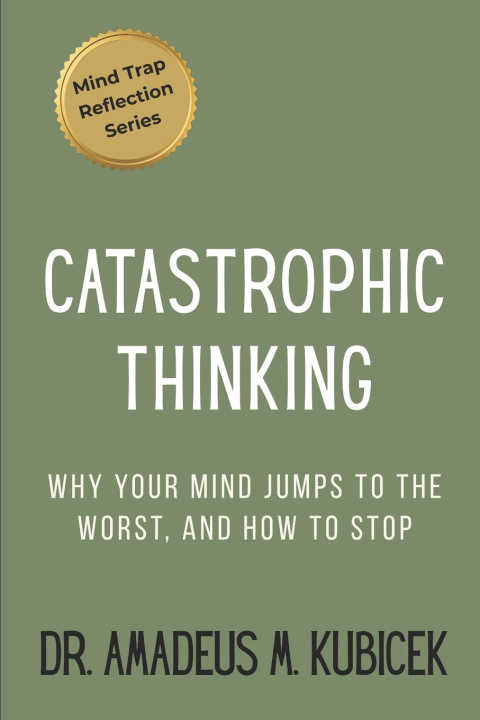
CATASTROPHIC THINKING:
Why Your Mind Jumps to the Worst, and How to Stop
You know the feeling. A message arrives without context and your mind is already building disaster scenarios. A minor symptom appears and within minutes you are researching the worst possible diagnosis. A conversation ends awkwardly and your thoughts spiral toward irreversible damage. You are not imagining these leaps - they are real, they are fast, and for many people they are relentless.
Catastrophic thinking is not a character flaw or a sign of weakness. It is a learned pattern of threat perception that once served a purpose. The problem is that in daily professional and personal life, it consumes mental energy, distorts decision-making, and keeps you in a state of low-grade alarm - even when nothing is actually wrong.
What This Book Addresses
This book examines why the catastrophizing pattern forms, what sustains it, and why well-intentioned efforts to "just think positively" tend to fail. It explores the gap between rational knowledge and emotional response - the frustrating experience of knowing a fear is unlikely while still feeling it as certain. Rather than offering a collection of techniques, it offers a clear explanation of the mechanism first, so the method that follows actually makes sense.
What This Book Offers
The Clarity Filter is the book's central framework - a four-step method built around Pause, Probability, Perspective, and Plan. It is designed to interrupt the catastrophizing sequence at the point where the mind leaps from concern to conviction. The framework is not a crisis tool for extreme moments; it is a daily practice for managing the ordinary catastrophizing that most people experience repeatedly across health, work, and relationships. The book works through the full arc: recognizing the pattern, understanding why it happens, applying the method, integrating it into daily routines, and sustaining progress through setbacks.
Reflect, Apply, and Build Insight
A Reference Guide is included with the book. It contains structured self-assessments across three sections - recognizing the pattern, applying the Clarity Filter, and sustaining change - along with guided reflection questions, five practical exercises, scenario-based integration activities, and a 30-day practice path. These tools are designed for honest personal reflection, not performance. They help readers identify their specific triggers, track genuine progress, and return to the practice when momentum stalls.
Who This Book Is For
This book is written for college-educated professionals who have already tried the standard approaches - journaling, mindfulness apps, breathing techniques - and found that the pattern keeps returning. It is suited to readers who want to understand the mechanism before they trust the method, and who prefer a sustained framework over a list of interchangeable techniques. It is not an introductory overview of anxiety, and it is not written for readers seeking clinical treatment guidance.
About the Author
Prof. Dr. Amadeus M. Kubicek, DBA is a behavioral-risk researcher, scientist, and lecturer whose multi-country doctoral research at Charles Sturt University examined the psychological, emotional, and cultural factors shaping risk perception, decision-making, and adaptive performance in organizations. With more than four decades of professional experience across high-risk industries. His work bridges rigorous research and applied practice, with published peer-reviewed research in leading academic journals and presented internationally across Europe, the United Kingdom, the United States, Australia, New Zealand, and the Middle East.
If the catastrophizing pattern has become a persistent part of how you move through your days, this book offers a grounded, research-informed path toward a different way of thinking


Informace o knize
Angličtina

Darujte tuto knihu ještě dnes
Je to snadné
1 Přidejte knihu do košíku a zvolte doručit jako dárek 2 Obratem vám zašleme poukaz 3 Kniha dorazí na adresu obdarovanéhoAhoj! Jsem Libroamiko, tvůj knižní rádce.
Jak ti můžu pomoct?