
 Kontakt
 Jak nakupovat
Doručení
Nákupní rádce
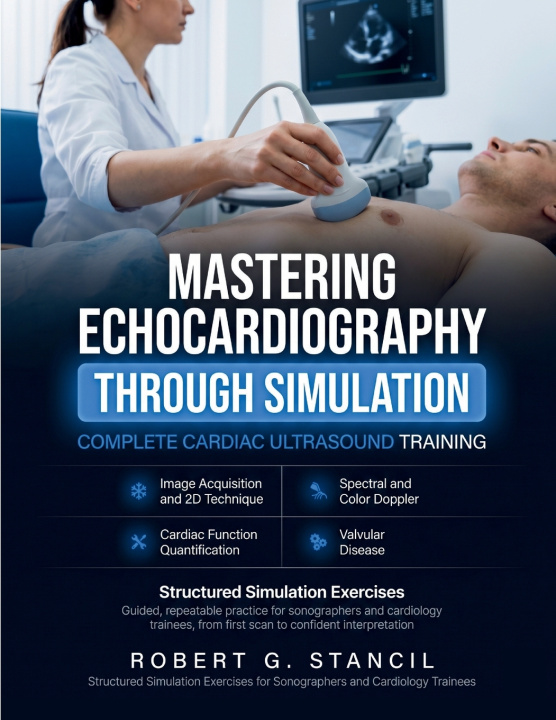
Mastering Echocardiography Through Simulation
Complete Cardiac Ultrasound Training in Image Acquisition, 2D and Doppler Techniques, Cardiac Function, and Valvular Disease with Structured Simulation Exercises for Sonographers and Cardiology Trainees
 Angličtina
 334 b
334 b
 Nové
Nové
30 dní na vrácení zboží

Mastering Echocardiography Through Simulation: Complete Cardiac Ultrasound Training in Image Acquisition, 2D and Doppler Techniques, Cardiac Function, and Valvular Disease
Echocardiography is a skill of the hands as much as the mind. Knowing what a view should contain is not the same as obtaining it cleanly on a patient and reading it with confidence. This book is built to bridge that distance, treating cardiac ultrasound as a competency developed through deliberate, repeatable practice and organizing the learning around structured simulation exercises.
The text follows the path a trainee actually takes. It begins with a framework for learning through simulation, then establishes the foundations of ultrasound physics, echocardiographic image formation, and the cardiac anatomy the echocardiographer relies on in every study. It then works through the acoustic windows in turn, the parasternal, apical, subcostal, and suprasternal views, presenting each as a practical skill with guidance on probe position, image optimization, and the common errors that undermine a study.
From there the book covers the full range of echocardiographic technique. Dedicated chapters address M-mode, pulsed wave and continuous wave spectral Doppler, color flow Doppler, and tissue Doppler with advanced applications. The quantification chapters cover linear measurements and normal reference values, area, volume, and systolic function, and diastolic function assessment. Valvular disease is addressed across separate chapters on the mitral valve and the aortic and right-sided valves. Later chapters reach into global longitudinal strain and speckle tracking echocardiography, and the advanced modalities of stress echo, contrast echo, three-dimensional echo, and point-of-care ultrasound.
Reporting standards are woven throughout. Reference ranges follow the American Society of Echocardiography, and valvular severity grading reflects ASE, ACC, AHA, and EACVI criteria. A chapter on echocardiographic reporting and quality standards shows how observations become a complete, clear study, and an integrated simulation laboratory of ten complete patient cases ties acquisition, measurement, and interpretation into a single connected workflow.
Inside you will find:
- A competency-based structure organized around structured simulation exercises.
- Step-by-step coverage of every standard acoustic window and imaging mode, from 2D through advanced Doppler.
- Quantification chapters with normal reference values, formulas, and measurement methods.
- Valvular disease severity grading aligned with ASE, ACC, AHA, and EACVI standards.
- Ten integrated patient simulation cases that connect individual skills into complete examinations.
Reference appendices covering ASE sex-specific reference ranges, key measurement calculations, and a valvular grading quick reference.
This book serves sonography students and registered cardiac sonographers, cardiology residents and fellows preparing for practice and credentialing, and clinicians developing point-of-care echocardiography skills. It is written to be worked through at the machine and kept at the workstation, so that each chapter leaves the reader more capable than the last.
Robert G. Stancil presents a training text built for the realities of learning echocardiography: clear foundations, systematic technique, and structured practice grounded in current professional standards.


Informace o knize
Angličtina

Darujte tuto knihu ještě dnes
Je to snadné
1 Přidejte knihu do košíku a zvolte doručit jako dárek 2 Obratem vám zašleme poukaz 3 Kniha dorazí na adresu obdarovanéhoAhoj! Jsem Libroamiko, tvůj knižní rádce.
Jak ti můžu pomoct?