
 Kontakt
 Jak nakupovat
Doručení
Nákupní rádce
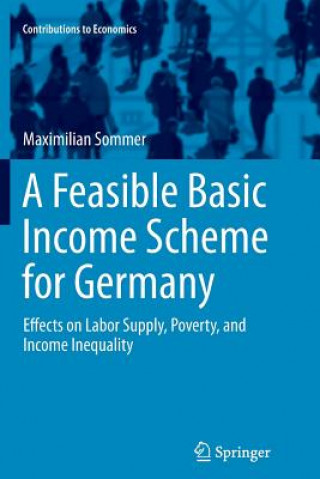
Feasible Basic Income Scheme for Germany
Effects on Labor Supply, Poverty, and Income Inequality
 Angličtina
 236 b
236 b
Až 30 dní na vrácení zboží
Zákazníci také koupili










 /
/
 Brožovaná
 1 115
Kč
1 115
Kč




 /
Brožovaná
881
Kč
/
Brožovaná
881
Kč







 /
/
 Audio CD
384
Kč
Audio CD
384
Kč


This book analyzes the consequences that would arise if Germany's means-tested unemployment benefits were replaced with an unconditional basic income. The basic income scheme introduced is based on a negative income tax and calibrated to be both financially feasible and compatible with current constitutional legislation. Using data from the German Socio-Economic Panel (GSOEP) the author examines the impact of the reform on the household labor supply as well as on both poverty and inequality measures. It is shown that by applying reasonable values for both the basic income and the implied marginal tax rate imposed on earned incomes, efficiency gains can be reconciled with generally accepted value statements. Furthermore, as the proposal includes a universal basic income for families, child poverty could be reduced considerably. The estimates are based on the discrete choice approach to labor supply.


Informace o knize
Angličtina
Kategorie

Darujte tuto knihu ještě dnes
Je to snadné
1 Přidejte knihu do košíku a zvolte doručit jako dárek 2 Obratem vám zašleme poukaz 3 Kniha dorazí na adresu obdarovanéhoMohlo by vás také zajímat







 /
Brožovaná
407
Kč
/
Brožovaná
407
Kč







Ahoj! Jsem Libroamiko, tvůj knižní rádce.
Jak ti můžu pomoct?