
 Kontakt
 Jak nakupovat
Doručení
Nákupní rádce
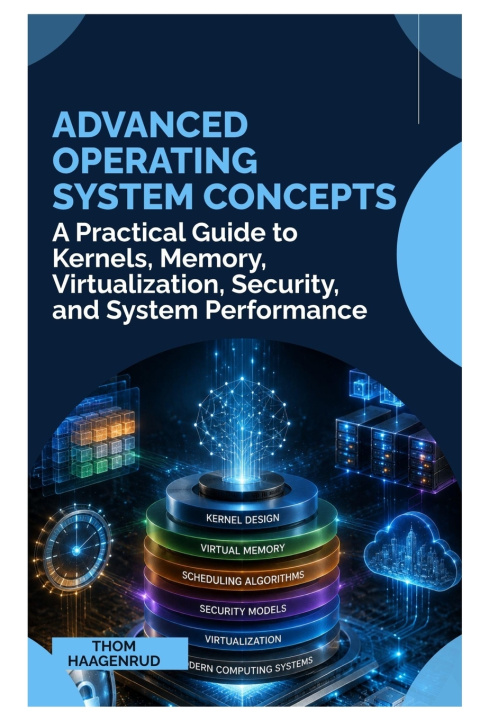
Advanced Operating System Concepts
A professional guide to understanding how modern operating systems manage processors, memory, storage, security, virtualization, and performance at scale
 Angličtina
 41 b
41 b
 Připravujeme
 Nové
Nové
Až 30 dní na vrácení zboží

What really happens between your application and the hardware?
Modern software can fail in ways that are impossible to understand from application code alone. A service can have plenty of CPU yet suffer terrible latency. More threads can make performance worse. A container can appear isolated while sharing the host kernel. A memory allocation can trigger storage I/O, while a scheduler decision can turn into a NUMA or contention problem.
Advanced Operating System Concepts takes you beyond textbook definitions and into the engineering decisions that shape real systems.
Written for developers and engineers who already understand basic programming, processes, threads, files, and networking, this book teaches you how to reason about the operating system as an active participant in application behavior.
Inside, you'll explore:
• Kernel architecture, execution contexts, system calls, interrupts, exceptions, modules, and drivers
• Processes, threads, file descriptors, signals, process creation, and copy-on-write
• CPU scheduling, fairness, real-time policies, affinity, multicore load balancing, and latency
• Virtual memory, page tables, TLBs, page faults, reclaim, huge pages, and NUMA
• Storage paths, filesystems, buffering, writeback, I/O queues, and durability
• Synchronization, mutexes, spinlocks, atomics, RCU, seqlocks, futexes, and lock-free design
• Security boundaries, privileges, capabilities, namespaces, seccomp, LSMs, and sandboxing
• Virtual machines, hypervisors, KVM, QEMU, containers, cgroups, and resource isolation
• Networking, IPC, event loops, asynchronous I/O, queues, and backpressure
• Profiling, tracing, PSI, eBPF, benchmarking, latency analysis, and failure investigation
• Heterogeneous hardware, accelerators, IOMMUs, memory tiering, programmable kernels, microVMs, and confidential computing
But this is not simply a collection of mechanisms.
Throughout the book, you'll learn a repeatable way to investigate difficult systems problems: identify the state, determine ownership, trace the transition, find the scarce resource, understand the ordering rule, examine the security boundary, and gather evidence before changing the system.
Practical Linux exercises, decision tables, troubleshooting patterns, integrated case studies, review questions, and a dedicated operating-system laboratory turn abstract concepts into engineering practice. The book deliberately connects subsystems so you can follow failures across CPU, memory, storage, networking, security, containers, and virtualization rather than treating each component in isolation.
Whether you're building high-performance services, debugging production latency, designing concurrent software, working with containers and virtual machines, or preparing for advanced systems engineering work, this book is designed to help you stop treating the operating system as a black box-and start reasoning about what it is actually doing.


Informace o knize
Angličtina
