
 Kontakt
 Jak nakupovat
Doručení
Nákupní rádce
An Illustrated Introduction to Quantum Mechanics
 Angličtina
 98 b
98 b
 Nové
Nové
Až 30 dní na vrácení zboží

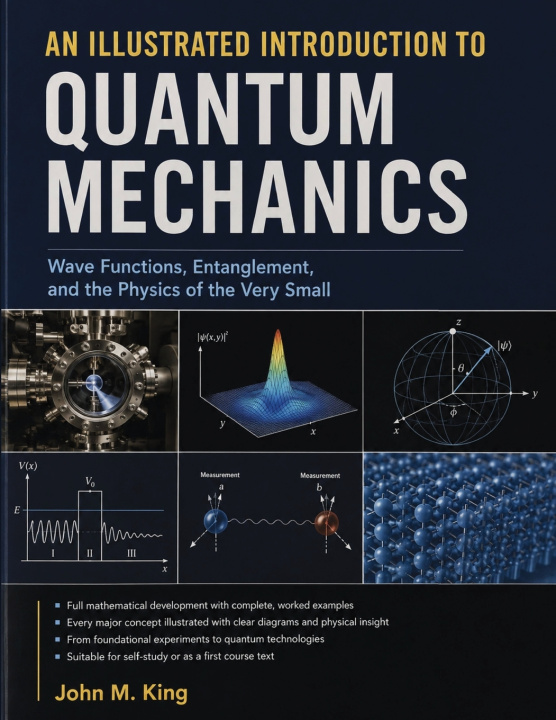
Quantum mechanics is one of the most talked-about theories in modern physics, and one of the hardest to actually learn on your own terms. Search for an explanation and two shelves turn up: books that describe the strangeness in plain English but stop the moment an equation would help, and textbooks that open with the mathematics fully formed, assuming coursework already behind you.
Readers stuck between those shelves keep meeting the same wall. A qualitative account can tell you that particles behave like waves, that measurement disturbs a system, that two distant particles stay correlated in ways no ordinary signal explains, but it cannot show you why, since that takes real mathematics worked through in full, with a picture beside it. A standard textbook has that mathematics, but rarely the visual scaffolding or patience for a reader starting from scratch.
This book closes that gap, developing quantum mechanics as a single connected progression: from the nineteenth-century experiments that forced physicists to abandon classical intuition, through the mathematics of quantum states and the equation governing how they change, into real solvable systems, and on to entanglement, quantum technologies, and interpretational questions a typical first course often treats as optional. Every idea is introduced once, illustrated with a diagram beside the discussion it supports, worked through in a complete example with every step and unit shown, and referenced rather than re-derived afterward.
Inside, you will be able to:
• Trace the experimental cracks that broke classical physics and see how each forced a genuinely new mathematical idea into existence.
• Represent a quantum state mathematically and use the wave equation governing how it evolves between measurements.
• Solve confined and barrier systems directly, connecting the results to real instruments, from imaging surfaces atom by atom to explaining wildly different radioactive decay rates.
• Follow angular momentum and intrinsic spin through to the shell structure that gives the periodic table its shape.
• Understand why identical particles split into two statistically distinct families, at work in everyday semiconductors and in the physics keeping the densest stars from collapsing further.
• Work through entangled states and the experimental tests built to rule out simpler classical explanations for their correlations.
• Get a technically grounded look at the quantum technologies now being built and the interpretational questions that remain genuinely unresolved.
Key subjects include the historical breakdown of classical physics, wave-particle duality, quantum states and measurement, exactly solvable bound systems and tunneling, angular momentum and spin, the hydrogen atom and multi-electron atoms, statistics of identical particles, approximation methods, entanglement and nonlocality, quantum computing and quantum-secured communication, and the leading interpretations of what the theory means.
This book is written for the reader who is curious rather than credentialed: comfortable with algebra and the basic idea of a derivative, willing to work through real equations, wanting to finish able to say, with genuine understanding, what a quantum state is and why the theory behaves as it does. It assumes no prior physics coursework, though it does assume a willingness to follow a derivation to the end. It suits a student wanting the conceptual picture behind formal coursework and a self-directed reader who has outgrown popular treatments of this subject.
Begin building a working understanding of quantum mechanics that popular explanations only gesture toward, developed here with the diagrams and derivations needed to make it genuinely your own.


Informace o knize
Angličtina

Darujte tuto knihu ještě dnes
Je to snadné
1 Přidejte knihu do košíku a zvolte doručit jako dárek 2 Obratem vám zašleme poukaz 3 Kniha dorazí na adresu obdarovanéhoAhoj! Jsem Libroamiko, tvůj knižní rádce.
Jak ti můžu pomoct?