
 Kontakt
 Jak nakupovat
Doručení
Nákupní rádce
 Angličtina
 34 b
34 b
 Nové
Nové
Až 30 dní na vrácení zboží

Artificial intelligence is more useful when we stop treating it like a one-answer machine.
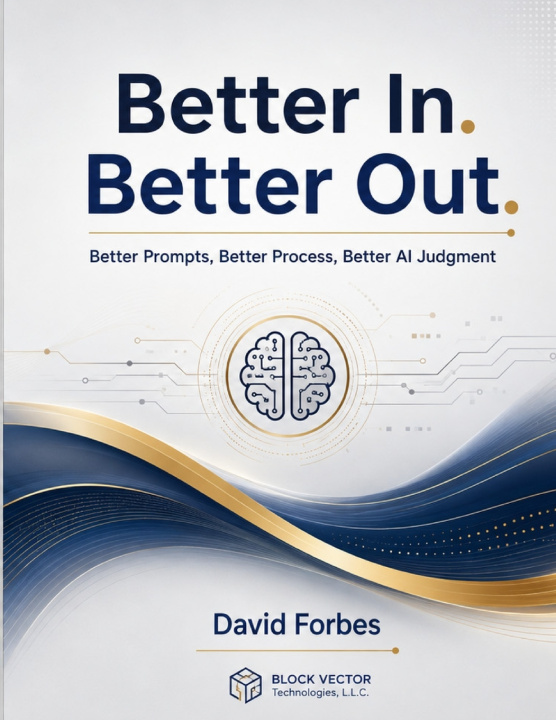
Better In. Better Out. is a practical guide to getting more useful, reliable, and thoughtful results from AI-not through clever prompts alone, but through better interaction.
David Forbes shows how better context, better questions, better correction, and better boundaries can turn a simple AI exchange into an iterative process for thinking, testing, refining, and improving. Instead of asking one question and accepting the first response, the reader learns to treat AI as part of a working process: provide context, examine the answer, challenge assumptions, correct errors, ask better follow-up questions, and keep refining until the result is genuinely useful.
But better answers are only the beginning.
As AI begins to influence real decisions, the standard must rise. Results should be verified. Authority should be recognized before action. Evidence should be preserved so important work can be reviewed, reproduced, and challenged when necessary. Human judgment remains essential, especially when an AI response may affect technical work, business decisions, research, policy, safety, or other consequential activity.
This book explores how to:
• Give AI the context it actually needs
• Ask better questions and refine them through conversation
• Correct errors, assumptions, and incomplete reasoning
• Distinguish a plausible answer from a verified result
• Use iteration instead of relying on a single prompt
• Preserve human judgment when AI informs real decisions
• Recognize when authority, evidence, and accountability matter
• Build a repeatable process that produces better outcomes over time
Better In. Better Out. is not a book about memorizing prompt formulas. It is about improving the quality of the entire exchange. The goal is not to make AI sound smarter. The goal is to make the work around AI more disciplined, more useful, and easier to trust.
That means knowing when to push for more context, when to question a confident answer, when to verify a claim independently, and when a system should stop rather than act beyond its authority. It also means preserving enough evidence that important work can be revisited later instead of disappearing into an opaque conversation.
The central idea is simple: the quality of AI-assisted work depends on more than the quality of the prompt. It depends on the quality of the process surrounding the prompt. Context changes answers. Follow-up questions expose gaps. Corrections improve direction. Verification separates useful information from plausible-sounding error. Boundaries determine what an AI system should recommend, what it should question, and what should remain a human decision.
The book also examines a shift that becomes increasingly important as AI moves from conversation into workflows and decision support. A useful answer is not automatically an authorized action. Confidence is not evidence. Fluency is not verification. And automation does not eliminate responsibility.
Readers are encouraged to treat AI output as something that can be examined, challenged, improved, and-when the stakes justify it-supported by evidence. The result is a more deliberate relationship with AI: one in which speed and creativity remain valuable, but judgment remains in control.
Written for professionals, executives, engineers, researchers, writers, consultants, and anyone using AI as part of serious work, the book offers a straightforward framework for moving from casual prompting toward deliberate, accountable use.
Better input matters. Better process matters more. Better judgment matters most.


Informace o knize
Angličtina

Darujte tuto knihu ještě dnes
Je to snadné
1 Přidejte knihu do košíku a zvolte doručit jako dárek 2 Obratem vám zašleme poukaz 3 Kniha dorazí na adresu obdarovanéhoAhoj! Jsem Libroamiko, tvůj knižní rádce.
Jak ti můžu pomoct?