
 Kontakt
 Jak nakupovat
Doručení
Nákupní rádce
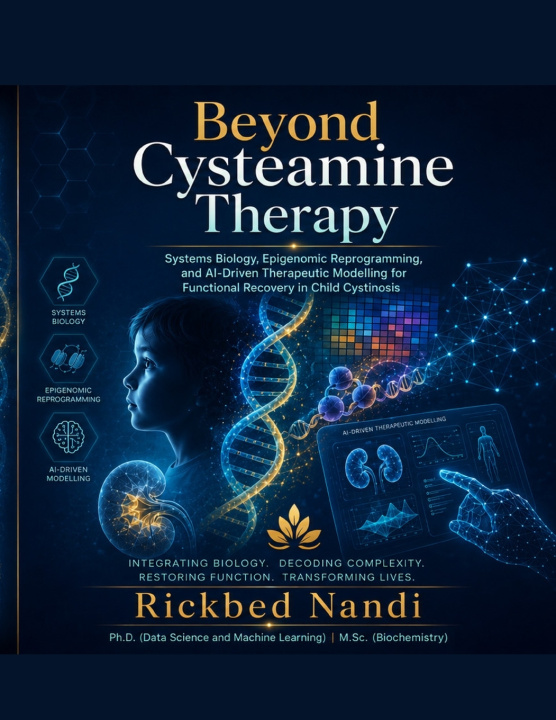
Beyond Cysteamine Therapy
Systems Biology, Epigenomic Reprogramming, and AI-Driven Therapeutic Modelling for Functional Recovery in Child Cystinosis
 Angličtina
 46 b
46 b
 Nové
Nové
Až 30 dní na vrácení zboží

Nephropathic cystinosis is a serious childhood lysosomal storage disorder caused by mutations in the CTNS gene. These mutations prevent normal removal of cystine from lysosomes and lead to progressive damage in many organs. Although cysteamine has changed the disease from a usually fatal childhood condition into a chronic adult disorder, many complications still continue over time. These include renal Fanconi syndrome, muscle weakness, hypothyroidism, hypogonadism, swallowing problems, and neurocognitive difficulties. This suggests that reducing lysosomal cystine alone is not enough.
This independently conducted and self-funded mixed-method study combines primary field observation with a large systems biology dataset containing 28 sheets and 25,000 rows. The dataset was curated from disease registries, peer-reviewed studies, structural databases, and clearly labelled computational expansions. The analysis used multi-omics integration, variant scoring tools, protein structure confidence mapping, molecular docking across six cystinosin conformations, and graph neural network drug repurposing methods.
The findings support a new understanding of cystinosis. Rather than being only a simple cystine storage disorder, it appears to be a network disease involving lysosomes, mitochondria, autophagy, and epigenomic regulation. Important findings include a gradual increase in the age at which renal replacement therapy begins, major pharmacokinetic differences between delayed-release and immediate-release cysteamine, stronger corneal improvement with Cystadrops than with low-dose cysteamine eye drops, widespread kidney DNA hypermethylation in Ctns knockout mice, and strong performance of an ensemble model for classifying CTNS variants.
The study also identifies several promising beyond-cysteamine therapeutic directions. These include bicalutamide plus cysteamine, mTOR inhibition, TFEB-CLEAR activators such as genistein and luteolin, mitochondrial antioxidants such as MitoQ and SS-31, and haematopoietic stem cell gene therapies including CTNS-RD-04 and DFT383.
Thus, the article proposes a unified framework in which functional recovery in child cystinosis will likely require combined action on cystine clearance, autophagy signalling, mitochondrial function, redox balance, and epigenomic regulation, with further progress accelerated by AI-driven therapeutic modelling.


Informace o knize
Angličtina
