
 Kontakt
 Jak nakupovat
Doručení
Nákupní rádce
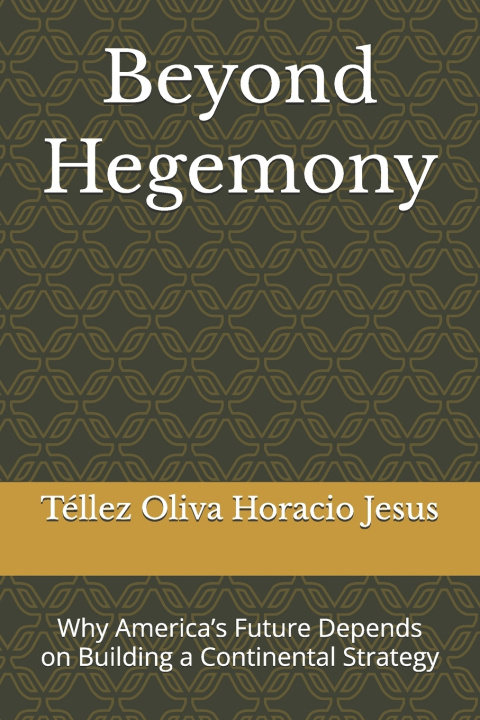
Beyond Hegemony
Why America's Future Depends on Building a Continental Strategy
 Angličtina
 40 b
40 b
30 dní na vrácení zboží

Beyond Hegemony advances a clear and uncomfortable thesis: the greatest strategic risk facing the United States in the twenty-first century is not external competition, but its inability to adapt to a world that has already become multipolar. The era of unquestioned hegemony is over. Persisting in it no longer preserves stability; it erodes it.
The book argues that America's long-term strategic future is inseparable from the fate of the Western Hemisphere as a whole. In a fragmented and volatile world shaped by energy shocks, supply-chain disruption, technological rivalry, and climate stress no major power can survive as an island of stability. The only realistic foundation for U.S. resilience is the construction of a Megamérica: a coherent, sovereign, and functional continental system.
Far from being an ideological or revisionist project, Beyond Hegemony proposes a structurally conservative strategy in the classical sense: preserving stability by adapting institutions to reality rather than clinging to obsolete reflexes. The book introduces the AURO Framework, a continental architecture designed to replace hegemonic control with structured cooperation, full respect for sovereignty, and mutual advantage.
AURO is neither a bloc nor a rigid alliance. It is a flexible framework based on variable geometry, allowing different levels of participation core, sectoral, or observer according to each country's capacities and political constraints. Crucially, it is designed to function under predictable resistance, short electoral cycles, and partial or uneven commitment.
The book analyzes the material pillars of continental stability in depth: energy (including Small Modular Reactors), logistics and industrial corridors, food sovereignty, technological autonomy, and institutional governance. It also examines the strategic cost of inherited policies such as the U.S. embargo on Cuba not from a moral standpoint, but through their measurable impact on hemispheric coherence, efficiency, and credibility.
Finally, Beyond Hegemony presents scenarios for 2030 and beyond, demonstrating that even partial continental coordination increases resilience, while continued fragmentation leads to strategic irrelevance.
This is not a call to restore dominance. It is a manual for redesigning stability and a warning: the window for continental coherence remains open, but it is closing.


Informace o knize
Angličtina
Kategorie

Darujte tuto knihu ještě dnes
Je to snadné
1 Přidejte knihu do košíku a zvolte doručit jako dárek 2 Obratem vám zašleme poukaz 3 Kniha dorazí na adresu obdarovanéhoAhoj! Jsem Libroamiko, tvůj knižní rádce.
Jak ti můžu pomoct?