
 Kontakt
 Jak nakupovat
Doručení
Nákupní rádce
 Angličtina
 28 b
28 b
30 dní na vrácení zboží

Most people don't think of themselves as failures.
They show up.
They handle responsibilities.
They keep their lives functioning.
And yet-beneath all of that-there is a quiet, persistent sense of being behind.
Not in a dramatic way.
Not as panic or collapse.
More like a low, constant pressure that never quite turns off.
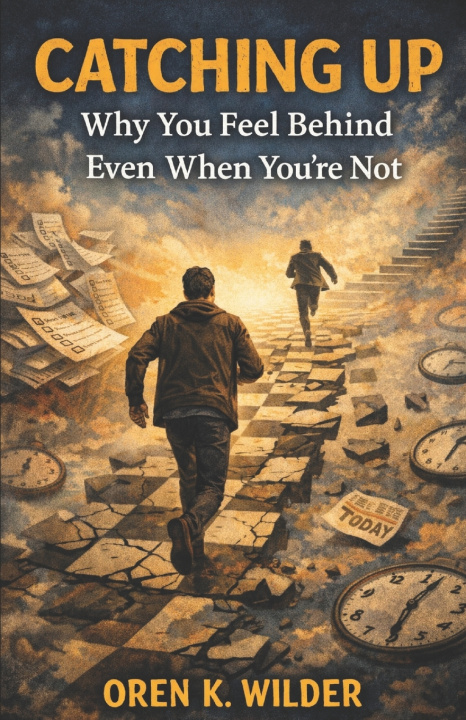
Catching Up is a book for people who are doing reasonably well on the surface but feel perpetually late to their own lives. People who can't point to a single mistake, missed milestone, or obvious problem-yet still feel as though something hasn't settled.
This book does not tell you how to get ahead.
It does not offer motivation, timelines, or corrective strategies.
It does not promise clarity, confidence, or momentum.
Instead, it examines where the feeling of being behind actually comes from-and why it persists even when nothing is objectively wrong.
Through clear, grounded prose, Oren K. Wilder explores how modern life quietly teaches people to measure themselves against invisible standards: imagined timelines, borrowed expectations, and abstract paces that were never designed for living bodies.
The book looks closely at:
• Why the feeling of being behind often intensifies during periods of stability
• How productivity quietly becomes a moral language
• The invisible timelines people absorb without consent
• Why comparison works even when you don't consciously engage in it
• How preparation replaces presence
• The nervous system's difficulty updating after instability
• Why "catching up" is not a real or lasting state
• How behind becomes an identity rather than an experience
• What changes when pace becomes livable instead of impressive
Rather than reframing the feeling or trying to eliminate it, Catching Up questions its authority.
It shows how the pressure to accelerate is often borrowed-not native-and how the urge to catch up persists precisely because there is nothing concrete to catch up to.
This is not a book about slowing down for its own sake.
It is a book about accuracy.
Accuracy about how living systems actually move.
Accuracy about how much strain constant self-evaluation creates.
Accuracy about why rest, stability, and unfinishedness often feel threatening in cultures that reward motion.
Readers who feel exhausted by self-improvement, overwhelmed by comparison, or quietly anxious during calm periods will recognize themselves here-not as broken, but as responding reasonably to environments that never stop asking for more.
Catching Up does not try to fix your life.
It does not tell you that you are secretly ahead.
It does not replace one ideal with another.
It simply removes a false pressure.
And for many readers, that removal is enough to make life feel inhabitable again.


Informace o knize
Angličtina

Darujte tuto knihu ještě dnes
Je to snadné
1 Přidejte knihu do košíku a zvolte doručit jako dárek 2 Obratem vám zašleme poukaz 3 Kniha dorazí na adresu obdarovanéhoAhoj! Jsem Libroamiko, tvůj knižní rádce.
Jak ti můžu pomoct?