 Kontakt
 Jak nakupovat
Doručení
Nákupní rádce
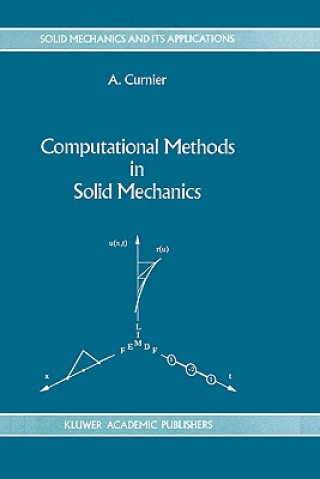
Computational Methods in Solid Mechanics
 Angličtina
 471 b
471 b
30 dní na vrácení zboží
Zákazníci také koupili


 /
/
 Brožovaná
 633
Kč
633
Kč













This volume presents an introduction to the three numerical methods most commonly used in the mechanical analysis of deformable solids, viz. the finite element method (FEM), the linear iteration method (LIM), and the finite difference method (FDM). The book has been written from the point of view of simplicity and unity; its originality lies in the comparable emphasis given to the spatial, temporal and nonlinear dimensions of problem solving. This leads to a neat global algorithm. Chapter 1 addresses the problem of a one-dimensional bar, with emphasis being given to the virtual work principle. Chapters 2--4 present the three numerical methods. Although the discussion relates to a one-dimensional model, the formalism used is extendable to two-dimensional situations. Chapter 5 is devoted to a detailed discussion of the compact combination of the three methods, and contains several sections concerning their computer implementation. Finally, Chapter 6 gives a generalization to two and three dimensions of both the mechanical and numerical aspects. For graduate students and researchers whose work involves the theory and application of computational solid mechanics.


Informace o knize
Angličtina
Kategorie

Darujte tuto knihu ještě dnes
Je to snadné
1 Přidejte knihu do košíku a zvolte doručit jako dárek 2 Obratem vám zašleme poukaz 3 Kniha dorazí na adresu obdarovanéhoMohlo by vás také zajímat

 /
Brožovaná
217
Kč
/
Brožovaná
217
Kč




 /
Brožovaná
444
Kč
/
Brožovaná
444
Kč



 /
Brožovaná
467
Kč
/
Brožovaná
467
Kč