
 Kontakt
 Jak nakupovat
Doručení
Nákupní rádce
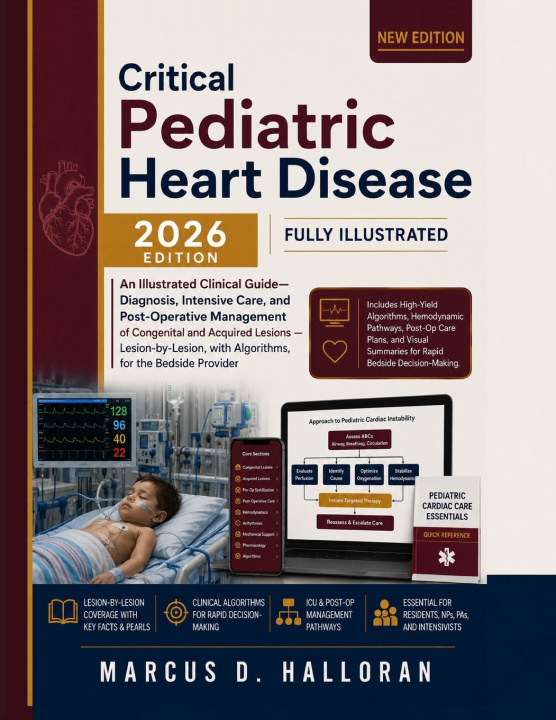
Critical Pediatric Heart Disease
An Illustrated Clinical Guide Diagnosis, Intensive Care, and Post-Operative Management of Congenital and Acquired Lesions - Lesion-by-Lesion, with Algorithms, for the Bedside Provider (2026 Edition)
 Angličtina
 455 b
455 b
 Připravujeme
 Nové
Nové
Až 30 dní na vrácení zboží

A newborn is pink at four hours and grey at ten. Nothing about the heart changed. The duct did.
Critical pediatric heart disease rarely announces itself. It arrives as a baby who feeds poorly, a toddler whose colour is "just how they are," a post-operative child whose numbers look acceptable while their liver edge quietly descends. The lesions are uncommon enough that most clinicians see them rarely - and consequential enough that the first hour decides the outcome.
This book is built for the person standing at that bedside.
Thirty chapters take you from fetal circulation and the transition at birth, lesion by lesion, through to intensive care physiology, post-operative management, and the conversation with the family. Every chapter follows the same architecture, so the book becomes navigable under pressure rather than only at leisure.
What makes this edition different
- A single visual language across all the chapters. One template learned once: the child on the left with the heart shown in place, the same heart enlarged on the right, and the lesion drawn as one change to a picture you already know. Tetralogy, transposition, coarctation and hypoplastic left heart stop being four things to memorize and become four alterations to one diagram.
- 64 purpose-built illustrations, drawn for teaching rather than decoration - where to put your hands, where the probe goes, which chamber lies nearest the front and why that is what you feel.
- Lesion-by-lesion coverage of congenital and acquired disease: septal defects, obstructive lesions, cyanotic lesions, single-ventricle physiology and the staged pathway, myocarditis and cardiomyopathy, Kawasaki and rheumatic disease, pulmonary hypertension.
- Physiology first, always. Why a duct-dependent lesion decompensates when the duct closes. Why rising saturations in single-ventricle physiology may signal deterioration, not improvement. Why normal blood pressure is often evidence of how hard a child is working, not of adequate output.
- Quick-reference decision tables, trimmed to what actually discriminates.
This book teaches recognition, mechanism and reasoning. It does not print drug doses, infusion rates, ventilator settings, saturation targets or laboratory thresholds - and that is a deliberate editorial decision, explained in full in the opening pages.
Those values are local: they differ between units, between countries, and between a cardiac center and the district hospital stabilizing a baby before transfer. They also change as guidance is revised, while a printed number carries the authority of print long after the evidence has moved. Use this book to understand the child in front of you. Use your institution's protocols and your formulary for every number you act on.
If you want a formulary, buy a formulary. If you want to understand why the protocol says what it says - and to recognize the child, the protocol has not anticipated - this book was written for you.
Who it is for
Pediatric and neonatal residents · NICU and PICU nurses · Nurse practitioners and physician assistants · Emergency physicians · General pediatricians · Respiratory therapists · Transport teams · Medical students on pediatric rotations


Informace o knize
Angličtina

Darujte tuto knihu ještě dnes
Je to snadné
1 Přidejte knihu do košíku a zvolte doručit jako dárek 2 Obratem vám zašleme poukaz 3 Kniha dorazí na adresu obdarovanéhoAhoj! Jsem Libroamiko, tvůj knižní rádce.
Jak ti můžu pomoct?