
 Kontakt
 Jak nakupovat
Doručení
Nákupní rádce
Cybersecurity
Foundations, Defense Strategies, and Emerging Threats: A Comprehensive, Practice-Driven Framework for Modern Security
 Angličtina
 167 b
167 b
 Připravujeme
 Nové
Nové
30 dní na vrácení zboží

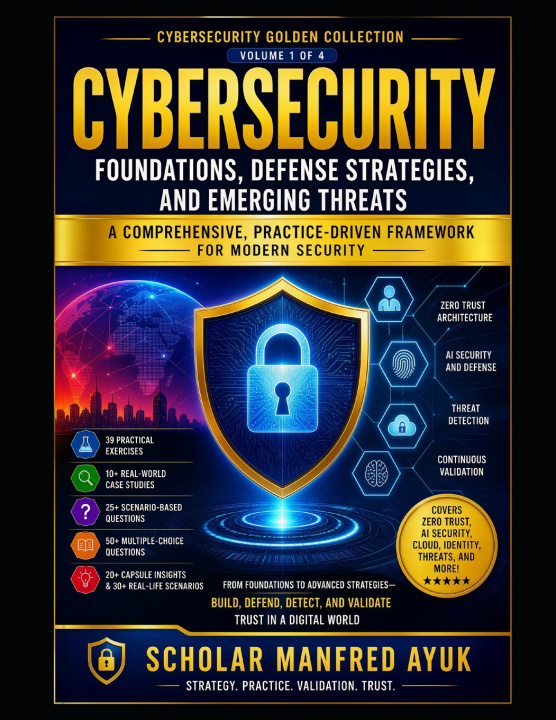
Cybersecurity: Foundations, Defense Strategies, and Emerging Threats by Scholar Manfred Ayuk is a comprehensive, practice-driven work that redefines how cybersecurity is understood, taught, and applied in the modern digital era. Positioned as Volume 1 of the Cybersecurity Golden Collection, the book moves beyond traditional technical explanations to present cybersecurity as a strategic, trust-centered discipline that integrates governance, risk management, adversarial thinking, Zero Trust architecture, and artificial intelligence (AI) security.
The book introduces a structured and unified cybersecurity model built on five interconnected layers: trust, governance, risk, threat, and validation. This framework enables readers to progress from foundational knowledge to real-world capability while ensuring that security is not assumed but continuously validated through measurable outcomes. At its core, the book emphasizes a critical shift-from preventing attacks to ensuring trust in systems, data, and intelligent decision-making processes.
A defining feature of this work is its integrated learning system, which combines theory, application, and analysis. The book includes 39 practical exercises, each designed to simulate real-world cybersecurity scenarios across domains such as endpoint protection, SIEM detection, application security testing, identity management, and data protection. Every exercise is paired with a technical response, providing step-by-step analysis, detection logic, control implementation, and strategic insights aligned with modern security practices.
To reinforce applied understanding, the book incorporates 10+ real-world case studies, including major incidents such as supply chain attacks and ransomware in healthcare, along with a comprehensive multi-stage case scenario that demonstrates how cyberattacks evolve from human exploitation to system compromise and business disruption. In addition, readers engage with 25+ scenario-based questions, 50+ multiple-choice assessments, and 30+ real-life scenarios, all designed to develop critical thinking and decision-making skills.
The book also features 20+ capsule insights, delivering concise, high-impact conceptual summaries that connect technical controls to strategic outcomes. These elements ensure that readers not only learn how cybersecurity works but also understand why it matters in organizational and societal contexts.
Key themes explored throughout the book include cybersecurity as a foundation of digital trust, the implementation of Zero Trust principles, defense-in-depth strategies, risk-based security, and the growing importance of AI security. Emerging challenges such as adversarial attacks, data poisoning, and model manipulation are addressed, extending cybersecurity beyond traditional systems to include intelligent and automated environments.
Designed for students, professionals, researchers, and decision-makers, this book serves as both a learning guide and a strategic framework. It bridges the gap between theory and practice while aligning with industry standards and modern security frameworks.
Ultimately, this book transforms cybersecurity from a reactive technical function into a proactive, adaptive, and trust-driven discipline-equipping readers to understand, validate, and continuously improve security in an increasingly complex and intelligent digital world.


Informace o knize
Angličtina
