
 Kontakt
 Jak nakupovat
Doručení
Nákupní rádce
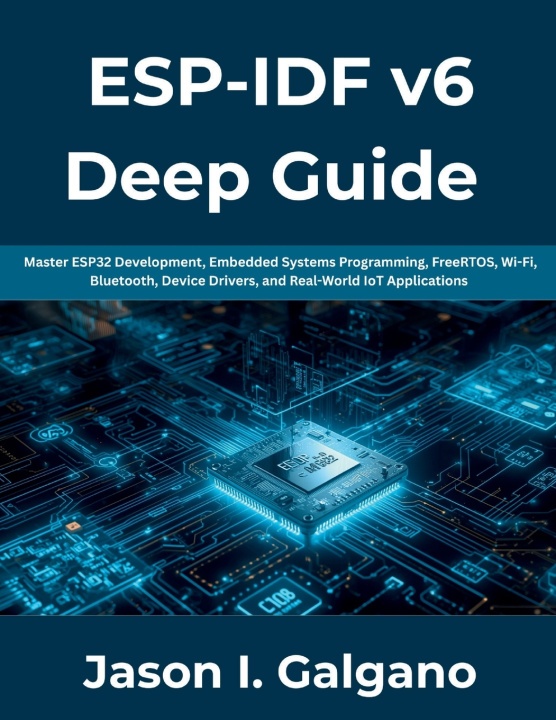
EeSP-IDF v6 Deep Guide
Master ESP32 Development, Embedded Systems Programming, FreeRTOS, Wi-Fi, Bluetooth, Device Drivers, and Real-World IoT Applications
 Angličtina
 69 b
69 b
 Nové
Nové
Až 30 dní na vrácení zboží

Have you ever looked at a small embedded device and wondered what actually brings it to life beneath the surface?
How does a microcontroller handle wireless communication, manage sensors, control hardware pins, and still stay stable under real-world conditions?
And more importantly, how do engineers build systems that don't just work in testing-but continue performing reliably in production environments?
This book was written to answer those questions in a structured and practical way.
ESP-IDF v6 Deep Guide is a comprehensive, hands-on exploration of modern embedded system development using the ESP-IDF framework. It is designed for learners and developers who want to move beyond basic examples and understand how real embedded systems are designed, organized, and deployed in production-ready environments.
Instead of focusing only on theory, this guide explains how core embedded concepts connect together in actual system design. You will see how low-level hardware control, real-time task management, communication protocols, memory handling, and cloud integration work as one complete system rather than isolated topics.
Have you ever struggled to understand how GPIO operations connect with real-time scheduling?
Or how data from sensors travels through communication protocols like UART, SPI, or I2C before reaching a cloud dashboard?
This book breaks those ideas down in a structured way so that each concept builds naturally into the next. It takes you through the full development journey-from understanding the ESP-IDF ecosystem and setting up a proper development environment, to building your first working application and progressing into advanced system design topics.
You will also explore how embedded systems handle timing, concurrency, and resource management in real-world conditions where precision matters. Topics such as task scheduling, inter-task communication, memory efficiency, and system stability are explained in a way that connects directly to practical engineering work.
Security and reliability are also treated as essential design principles rather than optional features. You will learn how embedded systems protect firmware integrity, manage updates, and maintain stable operation even when network or power conditions are unpredictable.
Communication systems such as MQTT, HTTP-based APIs, and cloud integration methods are explained in a way that shows how embedded devices interact with modern IoT infrastructures. Instead of treating these as separate technologies, the book shows how they fit into a unified system architecture.
Are you trying to understand how professional embedded systems are structured in real production environments?
Or are you looking to transition from basic microcontroller programming into scalable system development?
This guide is structured to support that progression.
Each chapter is written to help you think like a systems engineer-someone who understands not just how to write code, but how to design systems that are maintainable, secure, and efficient over time.
By the end of this book, you will have a clearer understanding of how embedded software and hardware interact at a deeper level, and how to approach system design with a production mindset.
If your goal is to build embedded systems that go beyond prototypes and can operate reliably in real-world deployments, this book gives you the structured foundation to move in that direction.


Informace o knize
Angličtina

Darujte tuto knihu ještě dnes
Je to snadné
1 Přidejte knihu do košíku a zvolte doručit jako dárek 2 Obratem vám zašleme poukaz 3 Kniha dorazí na adresu obdarovanéhoAhoj! Jsem Libroamiko, tvůj knižní rádce.
Jak ti můžu pomoct?