
 Kontakt
 Jak nakupovat
Doručení
Nákupní rádce
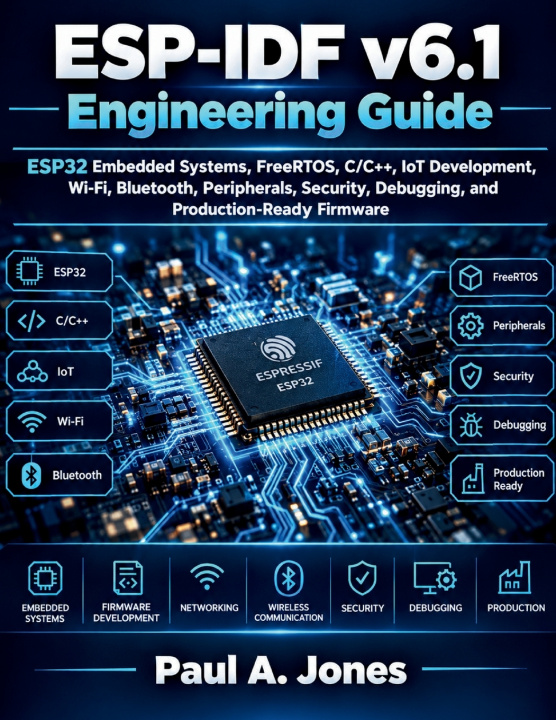
ESP-IDF v6.1 Engineering Guide
ESP32 Embedded Systems, FreeRTOS, C/C++, IoT Development, Wi-Fi, Bluetooth, Peripherals, Security, Debugging, and Production-Ready Firmware
 Angličtina
 69 b
69 b
 Připravujeme
 Nové
Nové
Až 30 dní na vrácení zboží

Are you looking for a practical way to understand ESP-IDF v6.1 and build reliable firmware for ESP32-based embedded systems?
Do you want to move beyond simple examples and learn how to structure real projects, manage components, work with FreeRTOS, handle memory, communicate over Wi-Fi and Bluetooth, secure firmware, perform OTA updates, troubleshoot failures, and prepare applications for production?
ESP-IDF v6.1 Engineering Guide is written for developers, embedded engineers, students, makers, and experienced programmers who want a structured reference for building serious embedded applications with ESP-IDF v6.1.
Instead of treating firmware development as a collection of unrelated examples, this book explains how the different parts of an embedded project fit together. You will learn how to organize projects, work with the build system, configure applications, manage components and dependencies, and develop C and C++ firmware that is easier to test, maintain, debug, and extend.
What happens when several FreeRTOS tasks need to share data? How should memory be allocated and released? What should your firmware do when a sensor stops responding or a network connection disappears? How can you investigate a watchdog reset or unexpected crash? How do you prepare an application for automated builds and production deployment?
These are the kinds of engineering questions addressed throughout the book.
You will learn about:
ESP-IDF v6.1 architecture, project organization, toolchains, configuration, and build workflows
C and C++ development for embedded applications
Component-based firmware architecture and dependency management
FreeRTOS tasks, queues, mutexes, semaphores, notifications, timers, and concurrency
Memory management, heap usage, task stacks, DMA considerations, and resource planning
GPIO, UART, SPI, I2C, I2S, ADC, PWM, timers, storage, USB, and other supported peripherals
Wi-Fi, Bluetooth, networking, sockets, HTTP, MQTT, provisioning, and connected-device communication
Secure communication, firmware protection, encryption, device identity, and secure provisioning
OTA firmware updates, rollback strategies, version management, and update reliability
Displays, touch interfaces, audio, cameras, sensors, USB applications, and edge-processing workloads
Logging, diagnostics, panic analysis, watchdog investigation, JTAG debugging, and crash analysis
Unit testing, integration testing, stress testing, hardware testing, and regression testing
Performance measurement, CPU utilization, memory optimization, latency, and real-time behavior
CMake-based builds, configuration management, version control, CI/CD, and automated workflows
Multi-target development and hardware-revision management
Production firmware architecture, factory testing, provisioning, release management, and lifecycle maintenance
The book also focuses on the decisions that become important when an application moves from a development board toward a dependable product. You will examine how to define component boundaries, establish resource budgets, design recovery procedures, manage persistent configuration, handle hardware failures, protect production devices, and create firmware that can be maintained over time.
Rather than assuming that every ESP32 family device has identical hardware capabilities, the book encourages target-aware development. This is important because available processors, peripherals, memory resources, wireless features, and security capabilities vary between device families.
You will also see how debugging, testing, automation, and production engineering connect together.


Informace o knize
Angličtina

Darujte tuto knihu ještě dnes
Je to snadné
1 Přidejte knihu do košíku a zvolte doručit jako dárek 2 Obratem vám zašleme poukaz 3 Kniha dorazí na adresu obdarovanéhoAhoj! Jsem Libroamiko, tvůj knižní rádce.
Jak ti můžu pomoct?