
 Kontakt
 Jak nakupovat
Doručení
Nákupní rádce
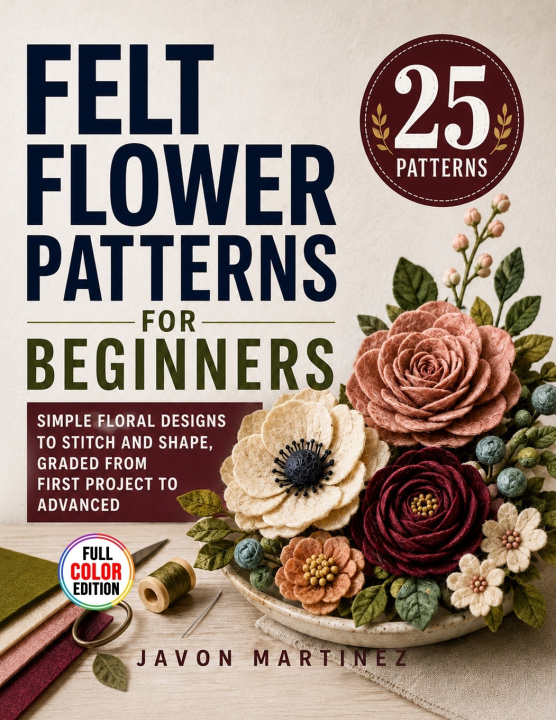
Felt Flower Patterns for Beginners
Simple Floral Designs to Stitch and Shape, Graded from First Project to Advanced
 Angličtina
 57 b
57 b
 Připravujeme
 Nové
Nové
Až 30 dní na vrácení zboží

Twenty-five patterns. Fifteen chapters. One steady progression from a clean first cut to a dinner-plate dahlia built in eight graduated rounds.
Felt Flower Patterns for Beginners starts before the first bloom, with the choices that decide how every later piece will look. You learn why wool blend felt holds a curved petal, how to transfer reusable templates, which scissors suit a tight inner curve, and how to keep pins, needles, and shears safely organized. No prior sewing experience is assumed. The opening technique chapters teach running stitch, whip stitch, ladder stitch, blanket stitch, French knots, and hidden tacking before those skills carry into the projects.
TWENTY-FIVE DESIGNS THAT BUILD ON EACH OTHER
- Begin with a five-petal daisy, a layered blossom, and a wired leaf pair, each marked at a foundational skill level.
- Shape classic roses, full blooms, buds, rolled roses, coiled rosettes, and a two-tone coil without losing control of the center.
- Move from individual stems to wildflower sprays, berry clusters, and fringed grass using wire gauges chosen for the weight they support.
- Arrange completed pieces on an eight-inch wreath form or along an adjustable garland, with practical guidance on spacing and balance.
- Add chalk pastel shading, sheer felt layers, and waved edges when a plain solid petal cannot supply the realism a bloom needs.
- Finish with orchids, a peony bud, a nine-inch dahlia centerpiece, and a seven-inch peony showpiece built on reinforced bases.
The sequence matters. Early projects use one stitch and one layer; later work asks you to combine petal-count planning, silhouette control, wire attachment, shading, ruffling, and structural reinforcement. Each pattern carries its own skill level, finished measurements, materials, needle size, notions, and special stitches, so you can see the demands before cutting any felt.
FROM FLAT SHEETS TO BOTANICAL FORM
Realistic blossoms depend on decisions that are easy to miss in a finished piece. The book shows where to deepen color at a petal base, how a sheer top layer changes the way light reads through a poppy, and why attachment angle controls whether a multi-round bloom looks closed, freshly opened, or flat. Fine-detail chapters cover orchid lips, uneven ruffles, and speckling, while statement-piece chapters explain petal growth across six to eight rounds and the heavier base discs those blooms require.
Troubleshooting sits beside the work it serves. Uneven cuts, loose joins, slipping sheer layers, blotchy chalk, weak stems, crowded wreaths, and drooping heavy blooms are traced back to the construction decision that caused them. A final reference section gathers techniques and recurring problems for quick return after the projects are finished.
These handmade florals can become bouquets, wreaths, garlands, centerpieces, gifts, or lasting home decor. Color substitutions and recorded combinations also give familiar constructions a fresh direction without changing the methods beneath them. Start with the daisy; the techniques for the largest bloom begin there.


Informace o knize
Angličtina

Darujte tuto knihu ještě dnes
Je to snadné
1 Přidejte knihu do košíku a zvolte doručit jako dárek 2 Obratem vám zašleme poukaz 3 Kniha dorazí na adresu obdarovanéhoAhoj! Jsem Libroamiko, tvůj knižní rádce.
Jak ti můžu pomoct?