
 Kontakt
 Jak nakupovat
Doručení
Nákupní rádce
 Angličtina
 51 b
51 b
Až 30 dní na vrácení zboží

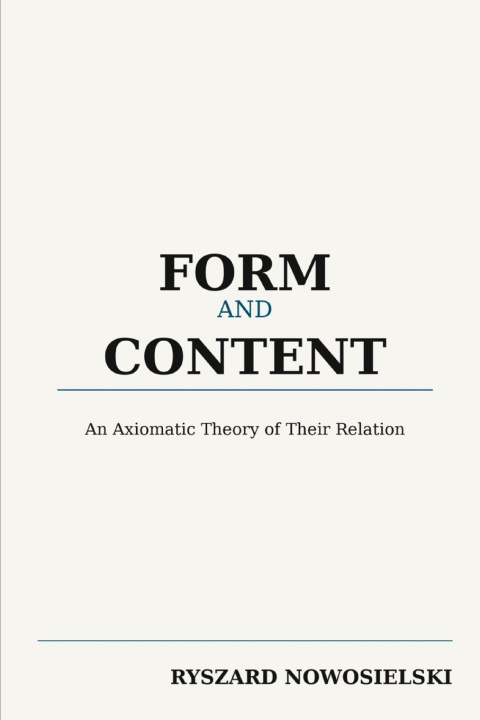
Form and Content: An Axiomatic Theory of Their Relation is a short, dense book about one question: what does form actually do to what we call content?
Drawing on philosophy, logic, media theory, architecture, and algorithmic systems, the book proposes twelve laws of form. These laws show why no medium, procedure, institution, interface, or genre is neutral; why forms always compress and saturate, fix horizons, impose costs, lag behind reality, and become irreversible once embedded in bodies and infrastructures.
Part I clarifies the problem and vocabulary of form, from Aristotle and Kant to category theory and information theory. Part II formulates the Twelve Laws-non-indifference, invariance, compression, saturation, scale, cost, delay, recursion, embodiment, constraint, horizon, and irreversibility-with minimal formal sketches and concrete examples. Part III applies the framework to language and logic, to rooms, stages, cities, calendars, rituals and algorithms, and to large apparatuses such as institutions, media systems, and technologies. Part IV is practical: it shows how to diagnose bad form (noise, kitsch, opacity, ideological structure) and how to choose and revise forms under real constraints of scale, attention, and path-dependence.
The epilogue marks the limit of any formal theory: pre-formal life, over-formalised experience, and the irreducible moment of moral decision, when a person must interrupt a form rather than obey it.
This is not a history of the idea of form and not a manifesto. It is a compact framework for people who design or inherit forms-writers, teachers, architects, system builders, administrators, platform designers-who need a precise language for what their formats, procedures and interfaces are really doing to the world.


Informace o knize
Angličtina

Darujte tuto knihu ještě dnes
Je to snadné
1 Přidejte knihu do košíku a zvolte doručit jako dárek 2 Obratem vám zašleme poukaz 3 Kniha dorazí na adresu obdarovanéhoAhoj! Jsem Libroamiko, tvůj knižní rádce.
Jak ti můžu pomoct?