
 Kontakt
 Jak nakupovat
Doručení
Nákupní rádce
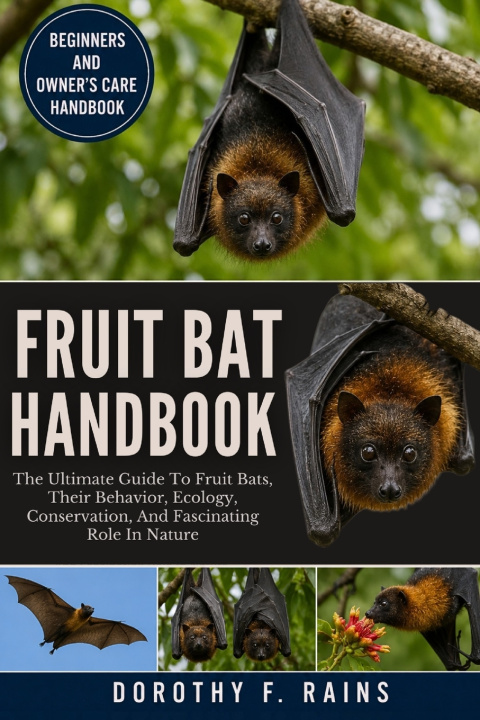
FRUIT BAT HANDBOOK
The Ultimate Guide To Fruit Bats, Their Behavior, Ecology, Conservation, And Fascinating Role In Nature
 Angličtina
 42 b
42 b
 Nové
Nové
Až 30 dní na vrácení zboží

Introduction
When most people hear the word "bat," they imagine a small, dark, fluttering creature darting through the night using mysterious echolocation. While that image fits many bat species, fruit bats are something altogether different. Large, expressive-eyed, and often surprisingly social, fruit bats-commonly known as flying foxes-represent one of the most fascinating and ecologically important groups of mammals on Earth.
Fruit bats belong to a group of bats that feed primarily on fruit, nectar, pollen, and plant material. Unlike most smaller insect-eating bats, many fruit bats rely heavily on vision and smell rather than echolocation to navigate and locate food. They are found across tropical and subtropical regions of Africa, Asia, Australia, and numerous Pacific islands, where they serve as vital pollinators and seed dispersers.
What Are Fruit Bats?
Fruit bats are members of a major lineage within the order Chiroptera, the scientific order that includes all bats. While bats are often divided broadly into two ecological groups-those that primarily eat insects and those that eat fruit-fruit bats are distinguished by their diet, physical characteristics, and sensory adaptations.
They are sometimes referred to as megabats due to their generally larger size compared to insect-eating microbats. However, not all fruit bats are enormous. Their sizes range from small species with wingspans under 30 centimeters to giant flying foxes whose wings can stretch over 1.5 meters from tip to tip.
What truly defines fruit bats is their plant-based diet. They consume ripe fruit, flower nectar, pollen, and occasionally leaves. Through this feeding behavior, they unintentionally perform ecological services that sustain forests and support biodiversity on a massive scale.
Why Are They Called Flying Foxes?
The name "flying fox" comes from their distinctive facial appearance. Many fruit bats have elongated snouts, pointed ears, and large eyes that give them a fox-like look. Combined with their fur-covered bodies and expressive faces, they appear less "bat-like" to some observers and more like small mammals with wings.
Their wings are formed from thin membranes of skin stretched over elongated finger bones. This structure is shared by all bats, but in fruit bats, the wings are often broad and powerful, allowing them to glide efficiently over long distances in search of food.
Physical Characteristics
Fruit bats possess several defining physical traits that set them apart from other bat species.
Large Eyes and Excellent Vision
One of the most notable features of fruit bats is their large, forward-facing eyes. Unlike many insectivorous bats that depend primarily on echolocation, fruit bats rely heavily on keen eyesight to navigate at night and locate fruiting trees. Their vision is well adapted to low-light conditions, allowing them to detect shapes, colors, and movement in dim environments.
Some species can even perceive ultraviolet light, enhancing their ability to identify ripe fruits and blooming flowers.
Strong Sense of Smell
In addition to sharp vision, fruit bats possess a highly developed sense of smell. This ability helps them detect ripe fruit from considerable distances. The sweet aroma of mangoes, figs, bananas, and other fruits serves as a beacon in the night.
Their reliance on scent explains why they are so effective at locating scattered food sources across vast landscapes.
Dentition Adapted for Fruit
Fruit bats have strong jaws and specialized teeth designed for crushing and processing soft plant material. Their molars are flattened and ridged to grind fruit pulp, while their canines help pierce tough fruit skins.
Unlike insect-eating bats, which have sharp, pointed teeth for catching and chewing insects, fruit bats are equipped for a plant-based lifestyle.


Informace o knize
Angličtina

Darujte tuto knihu ještě dnes
Je to snadné
1 Přidejte knihu do košíku a zvolte doručit jako dárek 2 Obratem vám zašleme poukaz 3 Kniha dorazí na adresu obdarovanéhoAhoj! Jsem Libroamiko, tvůj knižní rádce.
Jak ti můžu pomoct?