
 Kontakt
 Jak nakupovat
Doručení
Nákupní rádce
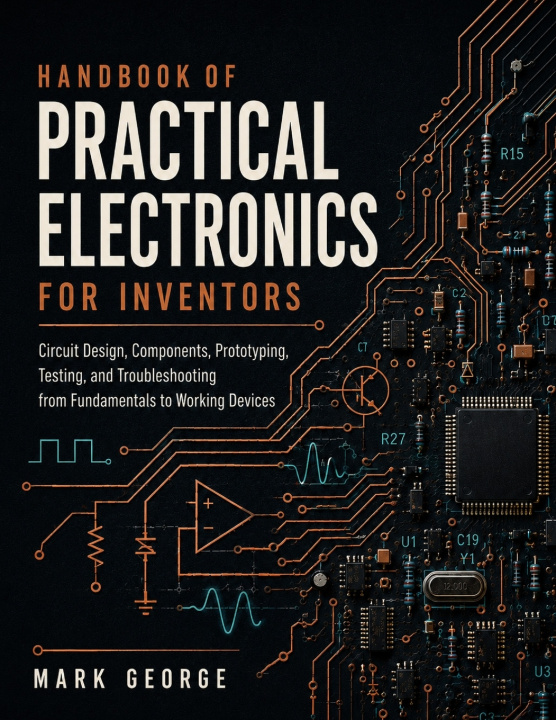
HANDBOOK OF PRACTICAL ELECTRONICS FOR INVENTORS
Circuit Design, Components, Prototyping, Testing, and Troubleshooting from Fundamentals to Working Devices
 Angličtina
 191 b
191 b
 Nové
Nové
Až 30 dní na vrácení zboží

A circuit can light an LED, spin a motor, respond to a sensor, or produce the correct voltage-and still be a weak design.
The real challenge in practical electronics is not simply making a circuit work once. It is understanding why it works, how each component affects the rest of the system, what happens when operating conditions change, how to measure performance correctly, and how to identify the real cause when something goes wrong.
This handbook is designed for readers who want to move beyond copying circuits and connecting components by trial and error. It develops the practical knowledge and engineering judgement needed to understand, design, build, test, troubleshoot, and improve real electronic systems.
Beginning with voltage, current, resistance, power, energy, grounding, and safe bench practice, the material progresses step by step into measurement, passive components, semiconductor devices, analog circuitry, timing systems, power electronics, digital logic, embedded control, sensing, communication, PCB implementation, reliability, and systematic troubleshooting.
Inside, you will learn how to:
- Understand voltage, current, resistance, power, energy, grounding, and return paths as they behave in real circuits-not just in equations.
- Use multimeters, oscilloscopes, signal generators, logic tools, and bench power supplies more effectively while recognizing measurement loading, uncertainty, grounding, and reference problems.
- Select and apply resistors, capacitors, inductors, diodes, transistors, MOSFETs, operational amplifiers, timers, and power components according to actual circuit requirements.
- Analyze component tolerances, parasitic effects, switching losses, thermal limits, startup conditions, noise, and other practical factors that can separate a reliable design from one that merely appears to work.
- Design and evaluate analog and digital circuits while understanding how individual stages interact within a larger electronic system.
- Interface microcontrollers and digital logic with sensors, actuators, motors, relays, communication buses, data converters, and mixed-signal circuitry.
- Understand power-supply architecture, regulation, batteries, current limiting, sequencing, decoupling, and power-distribution problems that frequently affect prototypes.
- Approach PCB layout, electromagnetic compatibility, thermal management, test access, component placement, reliability, and manufacturability as part of the electrical design itself.
- Troubleshoot systematically by predicting expected behavior, establishing known-good conditions, dividing systems into functional blocks, taking meaningful measurements, testing hypotheses, and changing one variable at a time.
At the heart of the handbook is a simple engineering cycle:
Predict. Build. Measure. Explain. Revise. Document.
Each stage turns uncertainty into evidence and helps transform a circuit that merely works into one you can understand, diagnose, reproduce, and improve.
If you are ready to stop simply assembling circuits and start understanding the decisions that make electronic systems work, open this handbook and begin building the practical knowledge, measurement discipline, and design judgement needed to turn electronic ideas into working devices.


Informace o knize
Angličtina
Kategorie

Darujte tuto knihu ještě dnes
Je to snadné
1 Přidejte knihu do košíku a zvolte doručit jako dárek 2 Obratem vám zašleme poukaz 3 Kniha dorazí na adresu obdarovanéhoAhoj! Jsem Libroamiko, tvůj knižní rádce.
Jak ti můžu pomoct?