
 Kontakt
 Jak nakupovat
Doručení
Nákupní rádce
 Angličtina
 34 b
34 b
 Nové
Nové
Až 30 dní na vrácení zboží

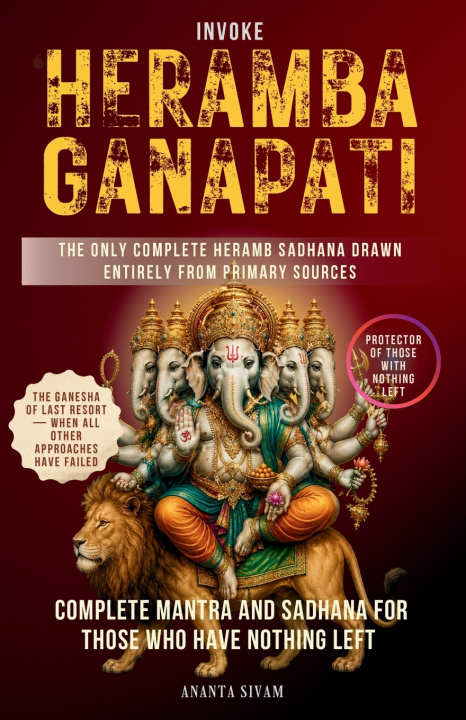
Not the Ganesha of Auspicious Beginnings
Every tradition has a form for the person who has exhausted every other option. The one who has managed, deployed every resource, called in every favour, and found that none of it has reached the root of what is blocking them. The Tantric tradition has a name for this condition: deenata. The state of having nothing left. And it has a form specifically oriented toward it.
His name is Heramb. He does not ride the mouse. He rides the lion.
The name itself is the first teaching. The syllable he signifies the one who is helpless, who has no support remaining. And ramba signifies the one who protects, who sustains what would otherwise fall. Heramb is not the Ganesha approached before a business venture or a wedding, to ensure the proceedings go smoothly. He is the form approached when the smooth proceeding has long since collapsed into something unrecognizable.
Five Faces. Five Cosmic Functions. One Complete Sadhana.The Panchamukha Ganesha is not an elaboration of the familiar single-faced form. He carries five heads arranged in the exact scheme that the Taittiriya Aranyaka of the Krishna Yajurveda assigns to the five faces of Sadashiva: Sadyojata facing west, Vamadeva facing north, Aghora facing south, Tatpurusha facing east, and Ishana facing the zenith. Each face carries its own cosmic function, its own element, its own Vedic mantra. The practitioner who stands before this form stands at the centre of a five-directional cosmic map, with creation, sustenance, dissolution, concealment, and revelation simultaneously present.
The southern face is blue-black in colour. It governs Samhara, dissolution, the ending of what has run its course. Its mantra is the Aghora mantra from the Taittiriya Aranyaka. The word Aghora, parsed accurately, means the absence of ghora, the absence of fear and turbulence. It is not a description of intensity. It is a description of the stillness that exists on the far side of dissolution, where what was agitating has dissolved.
Drawn Entirely from Primary SourcesThis book works from four primary textual foundations: the Mudgala Purana, which is the foundational Ganapatya text and the source of the Heramba Stotra spoken by Gauri herself; the Heramba Upanishad, which holds manuscript presence in the Government Oriental Library at Madras and declares this form to be Para-Brahman, the undivided supreme reality; the Cintyagama, one of the twenty-eight Shaiva Siddhanta Agamas, which gives Heramb his Agamic ritual authority; and the Taittiriya Aranyaka, whose tenth chapter preserves the five Panchabrahma mantras corresponding to his five faces.
No secondary sources. No popular compilations. No embellishment of what the tradition does not say.
What This Book ContainsTwenty chapters across five parts move from the etymology of the name through the complete iconographic reading, the philosophical foundations of the Heramba Upanishad and the Tripuradahana teaching, and the full mantra shastra, including the primary mantra with its complete word-by-word analysis, the Tantric sadhana mantra with Kar Nyas and Hridaya Nyas sequences, the Pancha-Brahma directional rotation puja, and the Shatkarma operations with their paddhati and karmic framework.
Six appendices include the Heramba Stotra from the Mudgala Purana, the complete Pancha-Brahma mantra matrix for all five faces in Devanagari, IAST, and translation, the dhyana shloka collection, the yantra geometry and consecration protocol, the idol material guide with Pushya Nakshatra timing, and the primary sources bibliography.
All mantras are given in Devanagari, IAST transliteration, and English translation.


Informace o knize
Angličtina

Darujte tuto knihu ještě dnes
Je to snadné
1 Přidejte knihu do košíku a zvolte doručit jako dárek 2 Obratem vám zašleme poukaz 3 Kniha dorazí na adresu obdarovanéhoAhoj! Jsem Libroamiko, tvůj knižní rádce.
Jak ti můžu pomoct?