
 Kontakt
 Jak nakupovat
Doručení
Nákupní rádce
 Angličtina
 42 b
42 b
Až 30 dní na vrácení zboží

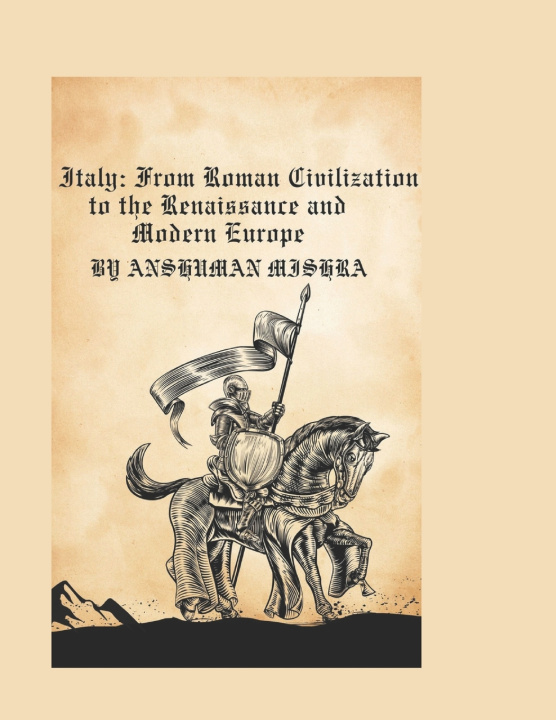
Human civilization is best understood not through isolated events, short political timelines, or the lives of individual rulers, but through long historical continuities-through the slow and layered evolution of culture, institutions, education, values, social structures, and collective memory across centuries. Italy: From Roman Civilization to the Renaissance and Modern Europe is a comprehensive, academically grounded, and reader-friendly exploration of one of the most influential civilizations in world history, presented with historical responsibility, cultural respect, and a long-view civilizational perspective.
Italy occupies a unique place in global civilization. It was the heartland of Italy ancient Rome, whose legal systems, governance structures, language, engineering, and civic ideals shaped Europe and much of the world. Centuries later, the same land became the birthplace of the Renaissance, a cultural and intellectual movement that transformed art, science, education, philosophy, and human self-understanding across continents. Modern Europe, in many ways, carries deep Italian civilizational imprints-from law and architecture to education, aesthetics, and political thought.
This book does not present Italy merely as a sequence of historical periods or political changes. Instead, it treats Italy as a living civilization-one that has continuously adapted, preserved, transformed, and transmitted knowledge across generations. By adopting a civilizational lens, the book connects ancient Rome, medieval city-states, Renaissance humanism, national unification, and contemporary European society into a single coherent historical narrative.
A Long-View Civilizational Approach
Rather than focusing narrowly on wars, dynasties, or ideological conflicts, this book emphasizes structural continuity and cultural evolution. It explores how geography shaped settlement patterns, how Roman institutions influenced governance, how Christianity transformed social life, how medieval cities revived trade and education, how Renaissance humanism reshaped learning, and how modern Italy balances tradition with change.
The book deliberately avoids sensationalism, political advocacy, or ideological debate. Its purpose is educational, reflective, and analytical. It aims to help readers understand how Italian civilization developed, why it mattered globally, and how its legacy continues to shape modern Europe and the interconnected world.
From Ancient Foundations to Roman Civilization
The opening sections of the book explore Italy's geographical and environmental foundations, explaining how the Italian peninsula's location in the Mediterranean made it a natural crossroads of trade, migration, and cultural exchange. Early prehistoric settlements, Italic tribes, and the Etruscans are examined not as isolated cultures but as contributors to the civilizational groundwork upon which Rome would later rise.
The rise of Rome is presented as a complex social and institutional process rather than a mythic or purely military story. The book carefully explains Roman family structures, social hierarchies, religious beliefs, legal traditions, and civic values. Special attention is given to the Roman Republic, highlighting how ideas of citizenship, rule of law, public service, and institutional balance emerged and evolved.
The Roman Empire is discussed as a vast administrative, cultural, and infrastructural system. Roads, aqueducts, urban planning, trade networks, education, and law are analyzed as civilizational achievements that enabled cultural integration across vast territories. The book emphasizes how Roman governance allowed local cultures to coexist within a shared legal and administrative framework-a key reason for Rome's long-lasting influence.


Informace o knize
Angličtina
