
 Kontakt
 Jak nakupovat

Doručení
Nákupní rádce
 Angličtina
 150 b
 Nové
Až 30 dní na vrácení zboží

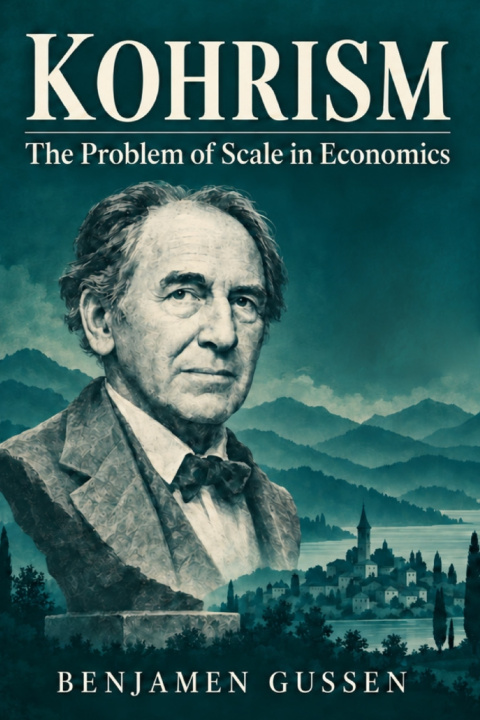
Kohrism: The Problem of Scale in Economics takes Leopold Kohr's provocation that "wherever something is wrong, something is too big" and turns it from a slogan into a testable approach to economic explanation. Its core question is under what conditions enlargement changes the benefits, costs and operation of an economic arrangement, and it insists that "scale" must be tied to a defined unit (firm, plant, market, network), a specified operation (replication, acquisition, densification, monetary rescaling) and a mechanism linking that operation to an outcome. Two worked models anchor the argument: a Heckscher-Ohlin trade model in which employment density enters sectoral productivity and so alters comparative-cost predictions, and a game-theoretic model showing that best responses shift when payoffs become relative rather than absolute, while proportional rescaling leaves results unchanged, which guards against the claim that any increase in size matters. The book then runs Kohr's idea through the major schools, including classical, Marxian, neoclassical, Austrian, Keynesian, monetarist, Post-Keynesian, institutional, evolutionary, development, ecological and behavioural economics. It argues that scale already appears in each in different forms and does not replace ownership, knowledge, demand, finance or behaviour as explanations. Instead, it identifies the conditions under which those mechanisms operate differently, and it closes by reframing scale as a disciplined tool for model building, with explicit limits and invariance cases.


Informace o knize
Angličtina

Darujte tuto knihu ještě dnes
Je to snadné
1 Přidejte knihu do košíku a zvolte doručit jako dárek 2 Obratem vám zašleme poukaz 3 Kniha dorazí na adresu obdarovanéhoAhoj! Jsem Libroamiko, tvůj knižní rádce.
Jak ti můžu pomoct?