
 Kontakt
 Jak nakupovat

Doručení
Nákupní rádce
Labour Density and Comparative Advantage
 Angličtina
 56 b
 Nové
Až 30 dní na vrácení zboží

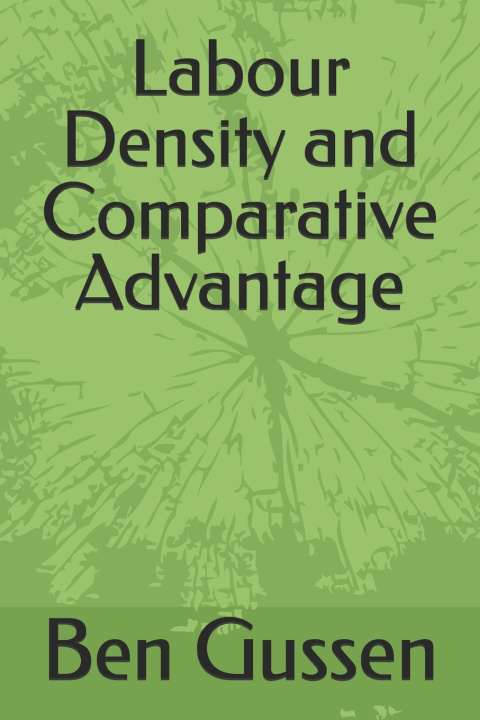
In Labour Density and Comparative Advantage, Ben Gussen examines the relationship between employment density, productivity and international trade. Extending the classical Heckscher-Ohlin framework, he investigates how the number of workers relative to available land can affect industries differently, changing relative production costs, factor rewards and patterns of specialisation. The central question is not simply how many resources an economy possesses, but how density influences the conditions under which those resources are used.
The book moves from U.S. county-level evidence to international manufacturing trade, connecting industry-specific density sensitivities with export performance. It examines the 1990 trade benchmark and follows the density-trade relationship across the 1990s, 2000s and 2010s. The baseline estimates reveal a change in the linear density interaction: positive in the 1990s and negative in the following two decades. Gussen explores this pattern alongside urbanisation, nonlinear effects and sectoral differences, considering the changing balance between the benefits of agglomeration and the costs of congestion. Throughout, the analysis distinguishes theoretical mechanisms from empirical associations and examines the sensitivity of its findings.
The discussion then turns to the governance of economic space. What does the density framework imply for understanding metropolitan congestion, regional connectivity and the geographic reach of public decision-making? Drawing on subsidiarity, the book examines the relationship between economic interactions and institutional responsibilities, while distinguishing these questions from the evaluation of any particular policy or governance model.
Bringing together trade theory, urban economics and economic geography, this scholarly monograph combines explanatory discussion with formal derivations, empirical tables and technical appendices. For researchers, postgraduate students and readers interested in regional development and political economy, it offers a framework for investigating how the spatial conditions of production enter the explanation of comparative advantage.


Informace o knize
Angličtina
Kategorie

Darujte tuto knihu ještě dnes
Je to snadné
1 Přidejte knihu do košíku a zvolte doručit jako dárek 2 Obratem vám zašleme poukaz 3 Kniha dorazí na adresu obdarovanéhoAhoj! Jsem Libroamiko, tvůj knižní rádce.
Jak ti můžu pomoct?