
 Kontakt
 Jak nakupovat
Doručení
Nákupní rádce
 Angličtina
 65 b
65 b
Až 30 dní na vrácení zboží

The contest between defenders and attackers has never been static - but something has shifted in the last few years that is qualitatively different from every previous change in the threat landscape. Artificial intelligence has not merely added new tools to both sides of the equation; it has rewritten the logic of the game itself. Attacks now arrive at machine speed. Defences must respond in kind. And yet the organisations caught in the middle are still largely led by people trained for an era that no longer exists.
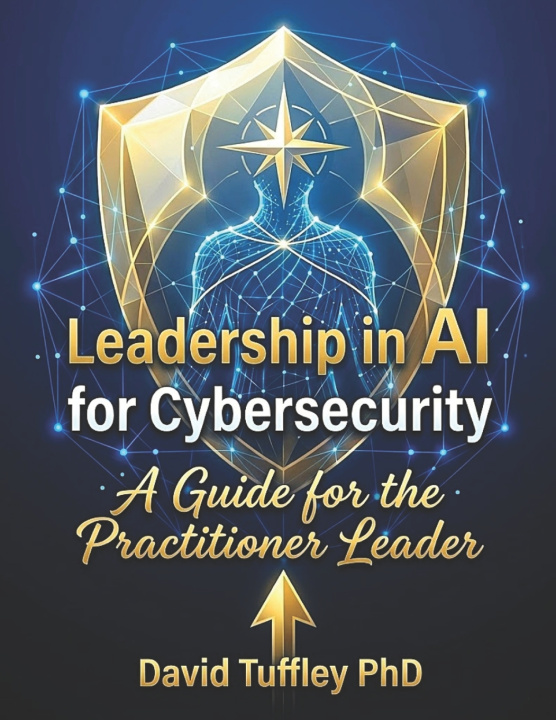
Leadership in AI for Cybersecurity is written for the security professional who senses that gap and intends to close it. Its author, David Tuffley PhD, is an internationally recognised cybersecurity researcher and writer whose work sits at the intersection of operational security leadership, AI governance, and the human dimensions of digital risk. This is not a book of theory without application, nor a vendor prospectus dressed up as strategy. It is a rigorous, practically grounded, and at times uncomfortable reckoning with what effective security leadership actually requires when intelligent machines become both weapon and shield.
The book opens by mapping the new terrain. The SolarWinds compromise - one of the most consequential supply chain attacks in history - provides an early case study, not as a technical post-mortem but as a leadership autopsy. What failed there was not detection capability. What failed was the organisational and strategic thinking that surrounds it. The CISO, the book argues, can no longer afford to be a technical guardian who occasionally attends board meetings. The role demands strategic fluency, earned credibility across the C-suite and the frontline alike, and a cognitive shift from reactive defence to proactive anticipation.
From this foundation the book moves into the daily reality of leading people inside AI-augmented security operations. How do you build genuine AI literacy across a team without producing the shallow familiarity that is, in some ways, more dangerous than ignorance? How do you redesign roles when automated systems absorb tier-one triage? How do you hire for the judgment and curiosity that no algorithm will replicate? These are not rhetorical questions. Each receives a considered answer, grounded in case studies drawn from healthcare providers, financial institutions, professional services firms, and government agencies.
The strategic chapters address risk quantification, threat intelligence, and incident response - not as processes to be optimised in isolation, but as leadership disciplines. The book is especially sharp on the command challenge of AI-assisted incident response: when a system can act in milliseconds, the question of who retains authority - and how - becomes urgent in ways that traditional IR playbooks cannot accommodate.
Governance, ethics, and accountability form the book's moral core. The chapter on the ethics of automated defence confronts the attribution problem head-on: when an autonomous system responds to an attack, crossing legal or ethical lines in the process, who is responsible? The treatment of regulatory literacy is similarly unsentimental, guiding readers through the patchwork of GDPR, the EU AI Act, NIST frameworks, and sector-specific obligations without pretending that compliance and security are the same thing.
The book closes by looking forward - at adversarial AI, at deepfakes and model poisoning and prompt injection as strategic threats, at the approaching horizon of quantum computing, autonomous agents, and AI-versus-AI conflict.
The answer, it turns out, is demanding. But it is also within reach - for those willing to read carefully, think honestly, and lead with both technical fluency and human judgment. This book shows them how.


Informace o knize
Angličtina

Darujte tuto knihu ještě dnes
Je to snadné
1 Přidejte knihu do košíku a zvolte doručit jako dárek 2 Obratem vám zašleme poukaz 3 Kniha dorazí na adresu obdarovanéhoAhoj! Jsem Libroamiko, tvůj knižní rádce.
Jak ti můžu pomoct?