
 Kontakt
 Jak nakupovat
Doručení
Nákupní rádce
 Angličtina
 61 b
61 b
30 dní na vrácení zboží

Philosophy and Vision:
"LLM: As an Operating System" is conceptualized around a singular philosophy: Democratization through Simplification. Complex AI architectures should not remain in the ivory towers of research labs. This book treats the Large Language Model not as a mystical "black box," but as a deterministic, manageable, and architectable component of a system-much like an Operating System kernel.
Pedagogy:
1. Concept Visualization: Every chapter begins with a high-level architecture equating AI concepts to standard OS concepts (e.g., Context Window = RAM).
2. Scaffolding: We will move from known (Traditional Coding) to unknown (Probabilistic AI), ensuring students build upon their existing CS knowledge.
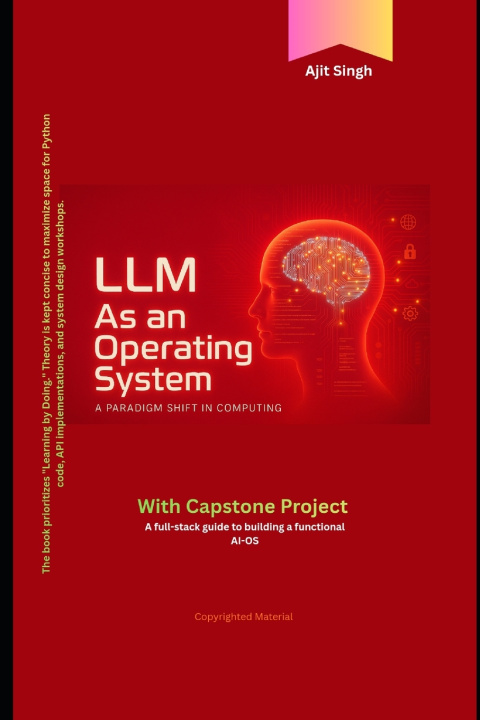
3. Experiential Learning: The book prioritizes "Learning by Doing." Theory is kept concise to maximize space for Python code, API implementations, and system design workshops.
Key Features:
1. Analogy-Driven Learning: The book uses the "OS Metaphor" consistently. If you understand how an OS manages threads, you will understand how an LLM manages agents.
2. Industry-Ready Syllabus: The content covers the latest frameworks (LangChain, AutoGPT, Vector DBs) required by top tech recruiters globally.
3. Code-First Approach: Over 40% of the book is code. Written in Python, the examples are modular, reusable, and hosted on GitHub (referenced in the book).
4. Capstone Project: A full-stack guide to building a functional AI-OS, ensuring the student walks away with a portfolio-ready project.
5. Global Compatibility: While rooted in AICTE norms, the syllabus covers the ACM and IEEE guidelines for Undergraduate AI education, making it suitable for US, UK, and European universities.
Target Audience:
1. B.Tech/B.E. Students (CS/IT/AI&DS): As a core textbook for Electives in Generative AI or Advanced Operating Systems.
2. M.Tech/Research Scholars: For understanding the system architecture of Agents.
3. Faculty Members: As a teaching manual to introduce Modern AI without discarding foundational CS theory.
4. Industry Professionals: For developers transitioning from Web2 to Web3/AI development.
Outcomes:
By the end of this book, a reader will not just know what ChatGPT is; they will know how to build a system that uses such models to read files, execute code, browse the internet, and solve complex problems autonomously.


Informace o knize
Angličtina

Darujte tuto knihu ještě dnes
Je to snadné
1 Přidejte knihu do košíku a zvolte doručit jako dárek 2 Obratem vám zašleme poukaz 3 Kniha dorazí na adresu obdarovanéhoAhoj! Jsem Libroamiko, tvůj knižní rádce.
Jak ti můžu pomoct?