
 Kontakt
 Jak nakupovat
Doručení
Nákupní rádce
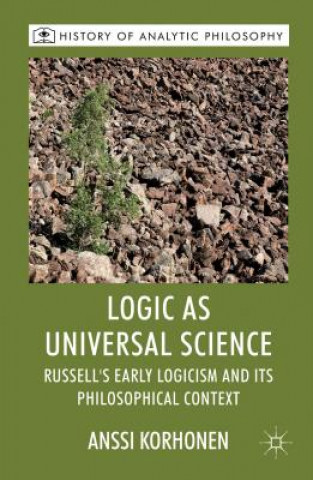
Logic as Universal Science
 Angličtina
 135 b
135 b
Až 30 dní na vrácení zboží
Zákazníci také koupili
















 /
/
 Brožovaná
 287
Kč
287
Kč


 /
Brožovaná
732
Kč
/
Brožovaná
732
Kč
 /
Brožovaná
612
Kč
/
Brožovaná
612
Kč



Bertrand Russell was a central figure in the rise of analytic philosophy, and there are few works in the genre whose influence is comparable to The Principles of Mathematics (1903), a book that established him as a major force in British philosophy. Logic as Universal Science takes a fresh look at the context of The Principles. This, it is argued, involves an extended argument against Kant's transcendental idealism and his conception of mathematics as a synthetic a priori science grounded in pure intuition. Philosophically, Russell's logicism substitutes pure logic for pure intuitions as the true source of mathematical knowledge. In this way, logic turns out to be a universal science and very far from Kant's general logic, which is a concise and dry science, delivering nothing but a purely formal criterion for knowledge. The picture of logic emerging from this opposition is investigated in detail for its content and consequences.


Informace o knize
Angličtina

Darujte tuto knihu ještě dnes
Je to snadné
1 Přidejte knihu do košíku a zvolte doručit jako dárek 2 Obratem vám zašleme poukaz 3 Kniha dorazí na adresu obdarovanéhoMohlo by vás také zajímat

 /
Brožovaná
989
Kč
/
Brožovaná
989
Kč






 /
Pevná
903
Kč
/
Pevná
903
Kč











Ahoj! Jsem Libroamiko, tvůj knižní rádce.
Jak ti můžu pomoct?