
 Kontakt
 Jak nakupovat
Doručení
Nákupní rádce
 Angličtina
 26 b
26 b
30 dní na vrácení zboží

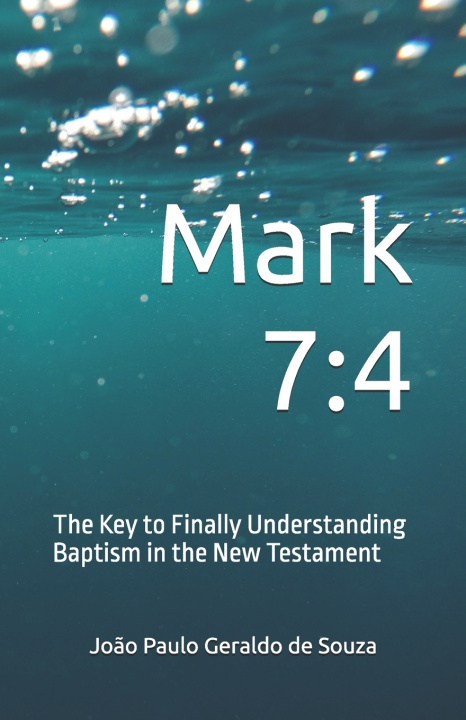
Is it possible to define the form of baptism in the New Testament? Yes. It was immersion.
Arguments defending sprinkling or other forms invariably turn to Mark 7:4, presuming the text can be used to defend their position. In fact, the text proves exactly the opposite: baptism can only be immersion.
Immersion was not a New Testament invention but was the most common form of purification established in the Old Testament. The Mishnah, which is the compilation of the tradition of the elders in the days of Jesus Christ, confirms that total immersion in the mikveh was what the Jews understood as the fulfillment of the purification commands in the Old Testament.
When a Jew was defiled with a first-degree impurity-for example, a woman in her cycle or a man who touched a corpse-depending on the case, they might even be sprinkled. But second-degree contact, which occurred when someone touched a person with a first-degree impurity, could only be purified by immersion. Thus, what Mark refers to is a person concerned because they might have touched a person contaminated in the first degree. This Jew could never sprinkle himself. The only ritual he could fulfill, based on the Old Testament and the tradition of the elders, was immersion.
The word baptizo did not undergo changes throughout history, at least until the 4th century AD. So we have its occurrences in the classical Greek period and throughout the centuries after Christ. It has always meant to immerse. A more precise definition found in the book is: to baptize is to insert into a medium so as to be completely enveloped by it. Thus, to baptize is solely to immerse.
To baptize cannot mean to wash. The term "wash" may seem innocent, but it carries much poison within itself. I can wash something without necessarily immersing that something. However, since to baptize can only mean to immerse, when I translate baptize as "wash," I am distorting the meaning of the word and opening the door for someone to claim that there are various forms of baptism just as there are various forms of ceremonial washings.
As the only term used by Christ to ordain the initiation rite of Christians, and the only term used in the New Testament to describe this practice, there is no possibility of altering the term. Every debate on the subject begins and ends with the definition of the term baptism. God chose a word that did not have various meanings in its time, because God is not a God of confusion.
We cannot-that is, we do not have authorization to-relativize what God did not relativize.
This book is the first part of a complete material on baptism, including its importance, meaning, form, formula, administrators, cause, and effect. It addresses a key text for understanding the form. So, there is still much ground to cover.


Informace o knize
Angličtina
