
 Kontakt
 Jak nakupovat
Doručení
Nákupní rádce
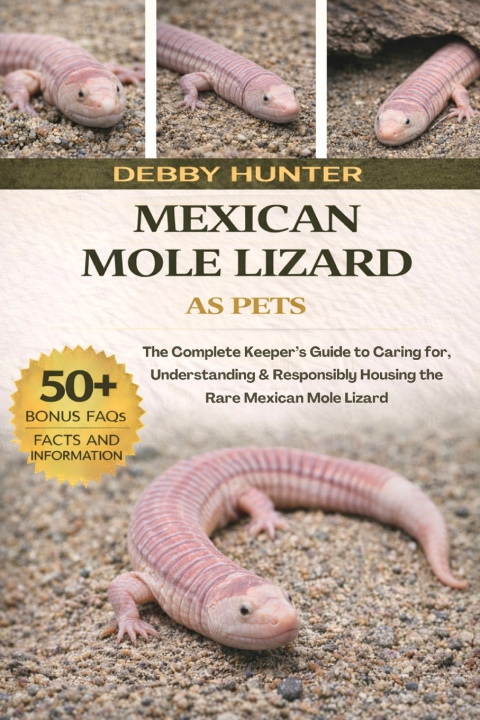
MEXICAN MOLE LIZARD
The Complete Keeper's Guide to Caring for, Understanding & Responsibly Housing the Rare Mexican Mole Lizard
 Angličtina
 37 b
37 b
Až 30 dní na vrácení zboží

Introduction to the Mexican Mole Lizard
Understanding Its Uniqueness, Rarity, and Evolutionary Significance
The Mexican mole lizard, known scientifically as Bipes biporus, stands as one of the most extraordinary and evolutionarily puzzling reptiles on Earth. At first glance it resembles a creature that should not exist-part lizard, part worm, part myth-yet it is a real, highly specialized, and incredibly ancient species whose entire body reflects millions of years of adaptation to a secretive underground life. Its rarity alone sparks fascination: this species is endemic to the Baja California Peninsula of Mexico, meaning it exists nowhere else in the world, and even within its native range it is seen far less often than other reptiles because it spends nearly its entire life beneath the soil. People can live their entire lives in Baja and never witness one, which contributes to the aura of mystery surrounding the species. Its uniqueness begins with its appearance. Unlike any other reptile, the Mexican mole lizard possesses two small but functional forelimbs while lacking hind limbs entirely. These forelimbs are not vestigial; they are powerful digging tools shaped like miniature paddles, giving Bipes biporus a distinctive look unmatched in the reptile world. Its long, smooth, segmented body resembles an earthworm or caecilian, but it is neither-it is a true lizard, entirely capable of shedding its skin, regenerating its tail, and displaying the anatomical hallmarks of squamate reptiles. The blend of lost limbs, retained forelimbs, and an elongated body makes it an evolutionary outlier, the only living species in the genus Bipes with this peculiar configuration. Unlike snakes, which lost all limbs, and unlike legless lizards that typically retain vestigial remnants or other unique structures, the Mexican mole lizard represents a rare evolutionary "middle path," one where nature reduced the body to a serpentine form while keeping just enough limbs to aid in burrowing through sandy soils. Even within the group known as amphisbaenians-a clade of subterranean, wormlike reptiles-the presence of forelimbs makes Bipes biporus stand apart. It is one of only three species within the entire amphisbaenian group that possesses limbs at all. This is a profound evolutionary detail, showing that even among highly specialized reptiles, Bipes biporus follows its own incredibly narrow evolutionary trajectory. Their rarity is not just geographic or behavioral-it is also evolutionary. Virtually all amphisbaenians evolved toward total limblessness as the most efficient body plan for moving beneath the earth, yet Bipes biporus retained its limbs, suggesting evolutionary stability in a configuration that simply works well for the conditions of Baja's loose sandy soils. This rare retention shows us that evolution is not always about complete transformations but about balance: the species found a functional design early in its lineage and has maintained it across millions of years. The evolutionary significance of the Mexican mole lizard extends deeper into its sensory and physiological adaptations. Over generations, its eyes have reduced in size but not disappeared, reflecting a lifestyle that benefits from basic light detection without needing visual detail. Instead of sight, the species relies heavily on touch, vibration detection, and acute mechanoreception to navigate its underground world. Its skull is uniquely reinforced for head-first burrowing, allowing it to push through soil efficiently, while the skin is arranged in ring-like segments called annuli, enabling smooth, accordion-like movement through tunnels without resistance. Unlike snakes, which use lateral undulation, Bipes biporus uses a linear motion that grips the soil with its body rings, pushing and pulling itself through tight spaces. This movement style is one of the clearest physical demonstrations of its evolutionary specialization.


Informace o knize
Angličtina
