
 Kontakt
 Jak nakupovat
Doručení
Nákupní rádce
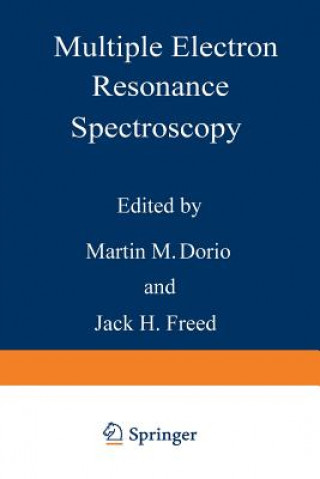
Multiple Electron Resonance Spectroscopy
 Angličtina
 118 b
118 b
Až 30 dní na vrácení zboží
Zákazníci také koupili









 /
/
 Brožovaná
 1 214
Kč
1 214
Kč







Abragam and Bleaney/H) and others.o6---19) Basically, this volume deals with those spectroscopic techniques that use EPR as a detection method. Chapters 2 through 5 cover the experimental and theoretical aspects of multiple resonance spectroscopy. Chapters 6 through 12 are systems-oriented and deal with the multiple resonance techniques applied to crystals, glasses, bioproteins, polymers, and triplets. The concepts of the first five chapters illustrate the strength of MERS to solve a broad range of problems. Chapters 13 and 14 are rather detailed introductions to two of the latest new applications: TRIPLE resonance and optical perturbations in EPR. The latter is to be distinguished from the OMDR (optical magnetic double resonance) techniques, in which the optical system is the detection method. References 1. E. J. Zavoisky, J. Phys. U.S.S.R. 9, 211 (1945). 2. J. S. Hyde, Ann. Rev. Phys. Chern. 25, 407 (1974). 3. N. M. Atherton, Electron Spin Resonance (Specialist Periodical Reports, The Chemical Society, London) 1, 32 (1972); 2, 35 (1974). 4. J. H. Freed, Ann. Rev. Phys. Chern. 23, 265 (1972). 5. J. E. Wertz and J. R. Bolton, Electron Spin Resonance, Elementary Theory and Practical Applications, p. xii, McGraw-Hill Book Co., New York (1972). 6. G. Feher, Phys. Rev. 103,834 (1956). 7. P. P. Sorokin, G. J. Lasher, and I. L. Gelles, Phys. Rev. 118, 939 (1960). 8. N. Bloembergen, S. Shapiro, P. S. Pershan, and J. O. Artman, Phys. Rev. 114,445 (1959).


Informace o knize
Angličtina

Darujte tuto knihu ještě dnes
Je to snadné
1 Přidejte knihu do košíku a zvolte doručit jako dárek 2 Obratem vám zašleme poukaz 3 Kniha dorazí na adresu obdarovanéhoMohlo by vás také zajímat
 /
Brožovaná
354
Kč
/
Brožovaná
354
Kč



 /
Brožovaná
359
Kč
/
Brožovaná
359
Kč













 /
Brožovaná
903
Kč
/
Brožovaná
903
Kč

 /
Brožovaná
221
Kč
/
Brožovaná
221
Kč
Ahoj! Jsem Libroamiko, tvůj knižní rádce.
Jak ti můžu pomoct?