
 Kontakt
 Jak nakupovat

Doručení
Nákupní rádce
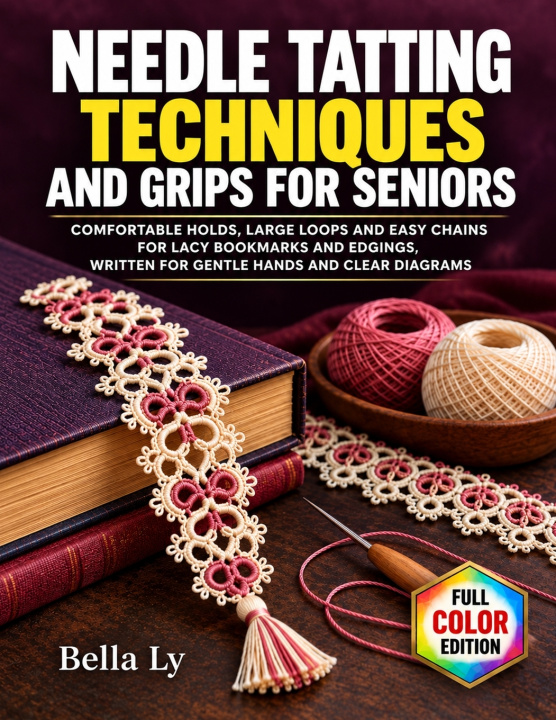
Needle Tatting Techniques and Grips for Seniors
Comfortable Holds, Large Loops and Easy Chains for Lacy Bookmarks and Edgings, Written for Gentle Hands and Clear Diagrams
 Angličtina
 58 b
 Připravujeme
 Nové
Až 30 dní na vrácení zboží

A tatting shuttle sits in a sewing box with its thread wound years ago, because the throw and the flip never felt steady in your fingers. Down the hall, a plain pillowcase and a folded handkerchief are waiting for the tatted lace trim you keep picturing along their hems, one neat scallop after another. You are not short on patience or taste, only on a tool that lets your hands set their own pace, one small stitch at a time, and on a teacher who explains each motion before asking for the next.
Needle tatting builds every double stitch on the shaft of a blunt needle, in plain view instead of thrown and flipped in midair, and that one change is what this book is built around from the first page.
Ten Chapters of Technique First
- Choose a needle size to match your thread, then hold it in a foam-tubing grip with your wrist kept straight and your fingers loose while you work
- Anchor the ball thread, set up a well-lit table, and work in crochet thread in size 10 or size 20, which is far easier to see than fine lace thread
- The double stitch, broken into nine small motions, with a short repair sequence for catching a backward stitch before it locks in place
- Large loops: leave the stitches loose along the needle, check each one by eye, then slide the group together and draw it to size without a struggle
- Picots of one even size, shaped with a picot gauge or a household spacer, and simple joins that link one ring to the next as the lace grows
- How to read a pattern line such as R: 4 ds, p, 4 ds, cl one instruction at a time, with a ruler under the row and a mark to hold your place
- Chains worked on a second thread, reverse work between chain and ring, and a fix for the ring that refuses to close cleanly
Only then do the four patterns begin. Each draws on skills you have already practiced alone, so a ring or a join never appears for the first time inside a project, and every pattern opens with a header block listing its thread, needle size and finished measurements.
Two Bookmarks, Two Lace Borders
- The Petal Row Bookmark joins ten rings in size 10 thread and ties on a dusty rose ribbon loop at each end for a simple first finish
- The Gentle Wave Edging alternates rings and chains in a scallop sized to trim a handkerchief, with long picots left for sewing it on
- The Rosette Row Bookmark clusters sixteen rings in size 20 thread, with rings that join into two picots at once for a fuller texture
- The Rose Trellis Border repeats rings, chains and picots into a deeper trim for a pillowcase or a tablecloth, with corner guidance
- Finishing: pin the piece on a blocking mat, add spray starch for a crisper edge, and wash it gently once it sees real use
Small embroidery scissors, a blunt-eyed tapestry needle, a ruler and rustproof pins make up most of the kit, and the Introduction names the rest, including a picot gauge. Blocking, starching and washing get a chapter of their own, written for tatters who want lacework projects finished properly.
Chapter 11 opens with a ten-ring bookmark in size 10 thread; read its header block first, then work the first ring.


Informace o knize
Angličtina

Darujte tuto knihu ještě dnes
Je to snadné
1 Přidejte knihu do košíku a zvolte doručit jako dárek 2 Obratem vám zašleme poukaz 3 Kniha dorazí na adresu obdarovanéhoAhoj! Jsem Libroamiko, tvůj knižní rádce.
Jak ti můžu pomoct?