
 Kontakt
 Jak nakupovat
Doručení
Nákupní rádce
 Angličtina
 36 b
36 b
 Nové
Nové
30 dní na vrácení zboží

Rome had known ruthless rulers before Nero.
But none quite like him.
Ascending the throne in AD 54 at just sixteen years of age, Nero began his reign under the careful guidance of experienced advisers and with the promise of stability for the Roman Empire. Within a decade, however, his rule had become synonymous with scandal, bloodshed, and spectacle.
He murdered his mother Agrippina, cast aside and executed his wife Octavia, and forced many of Rome's most respected figures-including the philosopher Seneca-to take their own lives. When a catastrophic fire destroyed much of Rome in AD 64, rumours spread that the emperor himself had watched the flames with artistic fascination. In the aftermath, Nero rebuilt the city according to his own vision and unleashed brutal persecution against the empire's growing Christian community.
Yet Nero did not see himself simply as ruler.
He wanted something far more unusual: recognition as an artist.
Travelling across Greece to compete in musical festivals, performing before vast audiences, and accepting crowns for his singing and poetry, Nero attempted to transform the image of the Roman emperor into something entirely new. To many Romans, it was a humiliation. To Nero, it was destiny.
But empires are not held together by applause.
As rebellion spread through the provinces and the political world withdrew its loyalty, the emperor who had filled theatres with music and spectacle found himself abandoned by the very system that had once raised him to power.
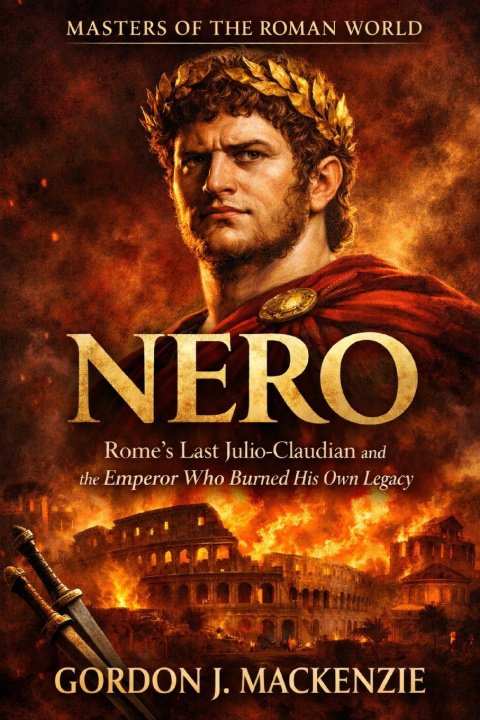
Drawing on the ancient histories of Tacitus, Suetonius, and Cassius Dio alongside modern scholarship, Nero: Rome's Last Julio-Claudian and the Emperor Who Burned His Own Legacy explores the dramatic life, reign, and downfall of one of Rome's most infamous rulers.
This is the story of ambition, vanity, spectacle, and collapse-and of the emperor whose name would become a warning across history.


Informace o knize
Angličtina
