
 Kontakt
 Jak nakupovat
Doručení
Nákupní rádce
 Angličtina
 65 b
65 b
 Nové
Nové
Až 30 dní na vrácení zboží

What are the limits of logic, knowledge, prediction, and authority?
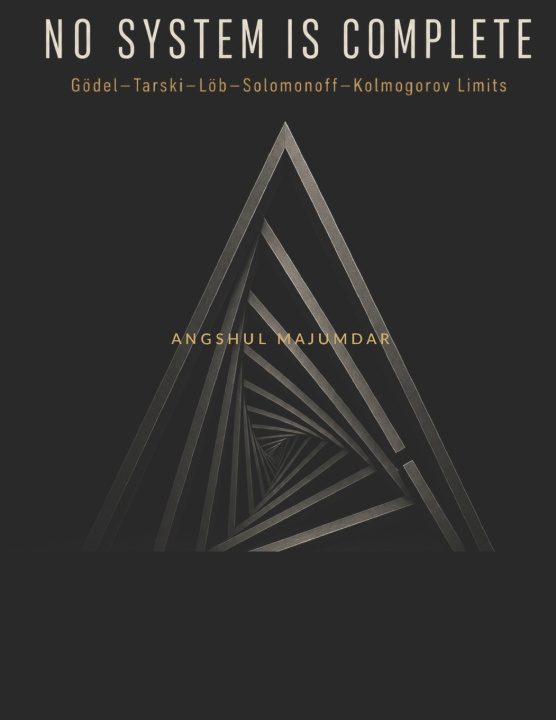
This book develops a unified intellectual framework around five of the deepest ideas in modern formal thought: Gödel's incompleteness, Tarski's undefinability of truth, Löb's theorem on self-certification, Solomonoff induction, and Kolmogorov complexity. Together, these five lenses show why no sufficiently expressive system can fully close itself from within, define its own truth without remainder, certify its own final authority, predict everything without irreducible uncertainty, or compress reality into a complete finite code.
The book is not a conventional philosophy text. It is a rigorous but readable study of formal systems and their boundaries. It begins with the mathematical and logical core: incompleteness, truth, provability, self-reference, prediction, compression, and algorithmic randomness. It then extends these ideas across a wide range of domains: set theory, artificial intelligence, social choice, political authority, distributed communities, religion, quantum mechanics, psychoanalysis, sport, and the recurring human dream of a final system.
The central thesis is simple but severe: wherever a system becomes expressive enough to speak about itself, organize itself, or claim final closure, a residue appears. This residue may take the form of undecidable propositions, undefinable truth, unstable self-certification, uncompressible information, unpredictable behaviour, interpretive surplus, or institutional breakdown. The names change across domains, but the structure recurs.
The book therefore treats Gödel, Tarski, Löb, Solomonoff, and Kolmogorov not as isolated technical results, but as instruments for understanding why total closure fails. A mathematical theory cannot contain all its truths. A language cannot define its own truth predicate without ascending to a meta-language. A system cannot certify its own reliability without circularity. A predictive machine cannot remove all dependence on prior structure. A compressed description cannot eliminate irreducible complexity.
These formal limits are then used to examine broader systems that claim completeness: axiomatic foundations, ideologies, theological systems, artificial general intelligence, social aggregation mechanisms, dictatorships, communes, and interpretive traditions. The goal is not to reduce these domains to mathematics, but to show that the same structural obstruction appears whenever a system attempts to become final.
This is a book for readers interested in logic, mathematics, computer science, philosophy, artificial intelligence, political theory, theology, and the architecture of knowledge itself. It is written for those who are comfortable with abstraction but do not want empty speculation. The style is formal where necessary, explanatory where possible, and uncompromising about the difference between genuine impossibility and loose metaphor.
At its core, the book argues that the dream of a final system is one of the oldest dreams of human thought. Gödel, Tarski, Löb, Solomonoff, and Kolmogorov show why that dream cannot be fulfilled on its own terms. Every system that tries to close the world must either weaken itself, contradict itself, appeal to something outside itself, or leave something unexplained.
The result is not despair. It is discipline. The failure of closure does not mean the failure of reason. It means that reason must understand its own architecture, its own limits, and the necessity of ascent.


Informace o knize
Angličtina

Darujte tuto knihu ještě dnes
Je to snadné
1 Přidejte knihu do košíku a zvolte doručit jako dárek 2 Obratem vám zašleme poukaz 3 Kniha dorazí na adresu obdarovanéhoAhoj! Jsem Libroamiko, tvůj knižní rádce.
Jak ti můžu pomoct?