
 Kontakt
 Jak nakupovat
Doručení
Nákupní rádce
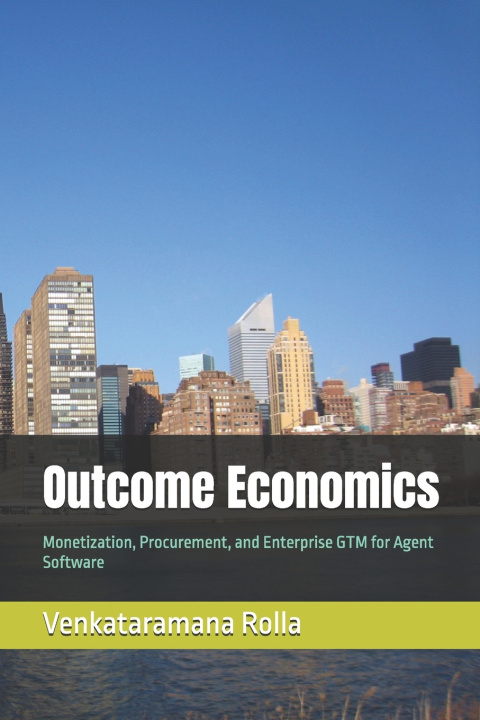
Outcome Economics
Monetization, Procurement, and Enterprise GTM for Agent Software
 Angličtina
 53 b
53 b
 Připravujeme
 Nové
Nové
Až 30 dní na vrácení zboží

Outcome Economics: Monetization, Procurement, and Enterprise GTM for Agent Software examines how the economics of enterprise software must change as AI systems move from assisting users to executing measurable business outcomes. Traditional SaaS monetizes access through seats, subscriptions, usage, and transactions; outcome-oriented software instead creates an opportunity to monetize verified results. The book develops a progression from seat-based pricing to usage, transaction, verified-outcome, and value-share models, while showing why token consumption and model usage should be treated as delivery costs rather than proxies for customer value. It introduces a hybrid commercial architecture in which a platform and governance fee is combined with outcome-based charges that are settled only after the defined result has been independently verified.
The book then addresses the difficult enterprise questions that arise when software is paid for based on outcomes: what exactly is being contracted, who receives credit for the result, and how can disputes be resolved? It presents a practical framework for Outcome Contracts, including operational baselines, attribution windows, deterministic policy invariants, execution gates, verification requirements, rollback boundaries, escalation states, SLAs, and audit evidence. It also explains how autonomous software can navigate enterprise procurement by connecting its economics to operational budgets, while providing security, risk, legal, finance, and procurement stakeholders with evidence rather than promises. Finally, the book establishes a supervised-to-high-autonomy commercial ramp in which increasing autonomy-and therefore increasing outcome economics-is earned through measurable operational performance, verification accuracy, intervention rates, and continuous governance.
The final part turns to the financial engine behind agentic software. It explains how inference, token consumption, retrieval, API calls, and execution infrastructure must be modeled as first-class delivery costs, and introduces techniques such as context clamping, model routing, semantic caching, structural caching, and hard reasoning boundaries to protect gross margins. The book ultimately connects autonomy, outcome growth, retention, customer acquisition economics, and valuation into a unified financial model for the emerging agentic software company. Its central progression is simple: Price the outcome → Contract the outcome → Attribute the outcome → Sell the outcome → Earn autonomy → Optimize the economics.


Informace o knize
Angličtina

Darujte tuto knihu ještě dnes
Je to snadné
1 Přidejte knihu do košíku a zvolte doručit jako dárek 2 Obratem vám zašleme poukaz 3 Kniha dorazí na adresu obdarovanéhoAhoj! Jsem Libroamiko, tvůj knižní rádce.
Jak ti můžu pomoct?