
 Kontakt
 Jak nakupovat
Doručení
Nákupní rádce
PLC Engineering
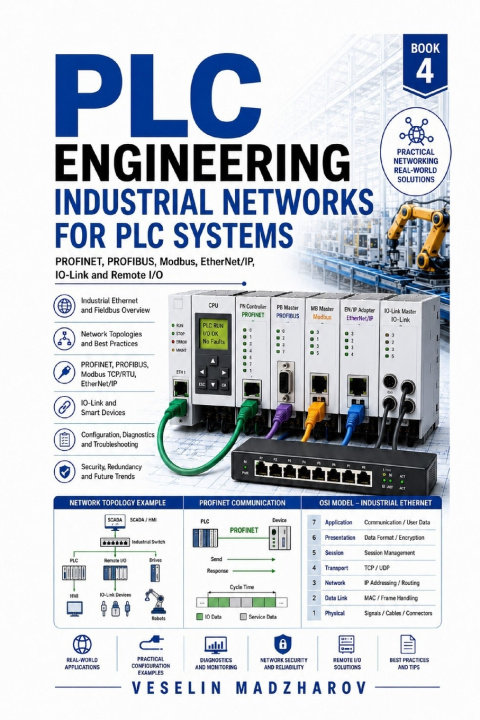
Industrial Networks for PLC Systems: PROFINET, PROFIBUS, Modbus, EtherNet/IP, IO-Link and Remote I/O
 Angličtina
 42 b
42 b
 Nové
Nové
Až 30 dní na vrácení zboží

PLC Engineering: Industrial Networks for PLC Systems is a practical guide to designing, configuring, commissioning, and troubleshooting communication networks used in modern industrial automation.
A PLC program may be correct and every field device may be functional, but production can still stop because of a duplicate IP address, damaged connector, incorrect termination, configuration mismatch, communication timeout, unstable topology, excessive network traffic, or electromagnetic interference.
This book explains how industrial networks connect PLCs, remote I/O stations, variable-frequency drives, sensors, actuators, HMIs, SCADA systems, robots, and intelligent field devices. The focus is not limited to communication theory. The book connects network principles with real commissioning, maintenance, and troubleshooting situations encountered in factories and automated machinery.
Readers will learn how industrial Ethernet and traditional fieldbus systems operate, how communication data moves between devices, and how to select appropriate star, line, ring, tree, and redundant network topologies.
The book covers PROFINET configuration and diagnostics, PROFIBUS addressing and termination, Modbus TCP and Modbus RTU communication, EtherNet/IP connections, IO-Link devices, and distributed remote I/O systems.
It also explains cyclic and acyclic data exchange, device addressing, network timing, managed industrial switches, VLANs, redundancy, diagnostic alarms, and communication recovery.
Practical troubleshooting methods show how to identify packet loss, duplicate addresses, unstable links, incorrect device names, damaged cables, poor connectors, missing termination, grounding problems, shielding errors, communication timeouts, and configuration conflicts.
Special attention is given to intermittent network failures that disappear after a machine restart. Readers will learn how to preserve diagnostic evidence, compare event timestamps, inspect device status, analyze switch counters, verify the physical network layer, and distinguish communication faults from PLC logic, electrical, or field-device problems.
The book also introduces industrial network security, segmentation, controlled engineering access, secure remote support, backup procedures, and recovery planning.
Practical tables, topology diagrams, configuration examples, diagnostic procedures, commissioning checklists, and real-world failure cases help transform technical concepts into methods that can be applied directly in the field.
This book is written for automation engineers, PLC programmers, electricians, maintenance technicians, commissioning specialists, system integrators, and technical students. The explanations are vendor-neutral and can be applied across different PLC and industrial communication platforms.
Understand the network. Diagnose communication failures systematically. Build industrial control systems that remain connected, secure, maintainable, and reliable.


Informace o knize
Angličtina

Darujte tuto knihu ještě dnes
Je to snadné
1 Přidejte knihu do košíku a zvolte doručit jako dárek 2 Obratem vám zašleme poukaz 3 Kniha dorazí na adresu obdarovanéhoAhoj! Jsem Libroamiko, tvůj knižní rádce.
Jak ti můžu pomoct?