
 Kontakt
 Jak nakupovat

Doručení
Nákupní rádce
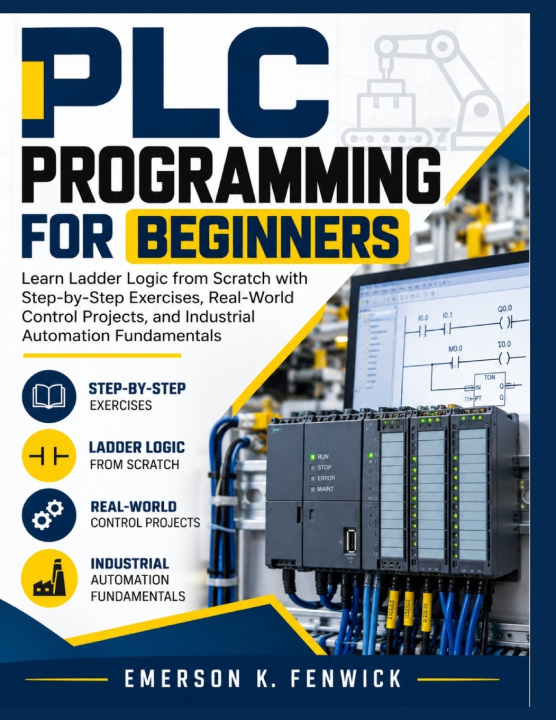
PLC Programming for Beginners
Learn Ladder Logic from Scratch with Step-by-Step Exercises, Real-World Control Projects, and Industrial Automation Fundamentals
 Angličtina
 80 b
 Připravujeme
 Nové
Až 30 dní na vrácení zboží

Want to understand PLC programming but don't know where to start?
PLC Programming for Beginners offers a structured introduction to programmable logic controllers (PLCs), ladder logic, and the fundamentals of industrial automation. Designed for learners building their knowledge from the ground up, this guide takes you from basic control concepts to writing, testing, and troubleshooting complete simulated automation projects.
Rather than relying on theory alone, you'll work through practical examples, guided labs, review questions, and step-by-step exercises that help you understand how PLC programs make decisions and control machine behavior.
What You'll LearnPLC Fundamentals: Understand how controllers, inputs, outputs, sensors, actuators, and feedback work together in an industrial control system.
Ladder Logic from Scratch: Learn rungs, contacts, coils, branches, logical conditions, and the PLC scan cycle.
Start/Stop Control: Explore seal-in circuits, command priorities, operational interlocks, reset conditions, and restart behavior.
Timers and Counters: Practice time delays, timeout detection, event counting, edge detection, and batch control.
Analog Signals and Data: Work with data types, comparisons, arithmetic, signal scaling, thresholds, and hysteresis.
Sequences and Automation Logic: Build sequential programs with operating modes, transitions, pause conditions, and fault recovery.
HMI and Alarms: Learn the fundamentals of operator interfaces, tag mapping, alarm acknowledgment, and communication loss.
Troubleshooting and Testing: Develop a systematic approach to finding logic errors, checking expected results, documenting tests, and maintaining program revisions.
The book uses Do-more Designer and its built-in Do-more Simulator to give you a software-based learning environment on a Windows computer. You can practice PLC logic without purchasing a physical controller or connecting equipment.
As you progress, you'll work toward three integrated projects:
Conveyor counting and batch control
Tank filling and draining
Two-station transfer and sorting
Each chapter builds on earlier concepts through worked examples, practical labs, prediction exercises, review questions, and explanations. Lab solutions and reusable project and test templates are included to support independent practice.
Who Is This Book For?This guide is suitable for beginners exploring PLC programming, students studying industrial automation, aspiring controls technicians, and technically minded readers who want a clearer understanding of machine-control logic.
You can begin with basic electrical and control concepts, then progress toward organizing requirements, designing logical sequences, testing simulated programs, and documenting your results.
Start learning PLC programming one concept at a time. Build your understanding of ladder logic, develop practical troubleshooting habits, and take your first steps toward industrial automation with a structured, hands-on learning approach.


Informace o knize
Angličtina

Darujte tuto knihu ještě dnes
Je to snadné
1 Přidejte knihu do košíku a zvolte doručit jako dárek 2 Obratem vám zašleme poukaz 3 Kniha dorazí na adresu obdarovanéhoAhoj! Jsem Libroamiko, tvůj knižní rádce.
Jak ti můžu pomoct?