
 Kontakt
 Jak nakupovat
Doručení
Nákupní rádce
Practice to Mastery
U.S. High School Environmental Science
 Angličtina
 118 b
118 b
 Připravujeme
 Nové
Nové
Až 30 dní na vrácení zboží

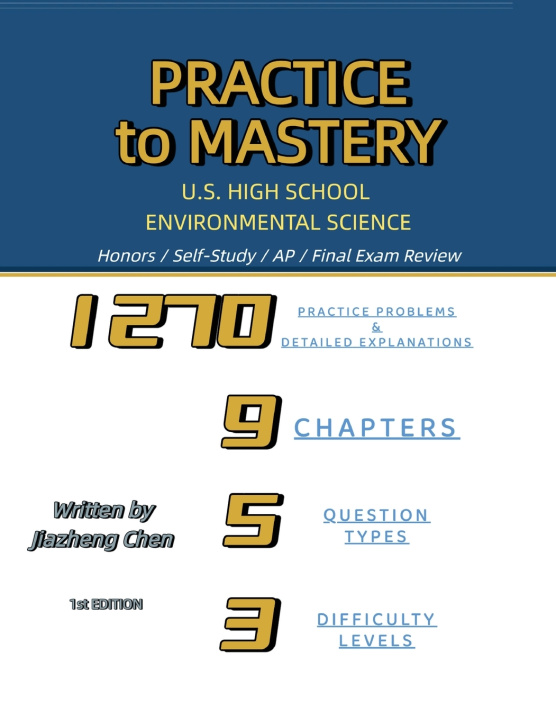
1,275 original practice questions. A worked explanation for every single one.
Environmental science asks students to do something unusual: to reason quantitatively about messy, real systems - a watershed, a fishery, a power grid, an atmosphere - using tools borrowed from biology, chemistry, earth science, and economics. Recognizing a definition is not the same as being able to use it. This workbook is built to close that gap.
Nine chapters cover the full scope of a year-long high school environmental science course: ecosystems and biogeochemical cycles; biodiversity and ecosystem services; populations and human demography; Earth's physical systems; land and water use; energy resources; air pollution; pollution of water and land and its effects on human health; and global change.
Each chapter presents five distinct question types, so that students are tested the way the subject is actually practiced:
Part A - Single-Answer Multiple Choice. Exactly one correct answer. Builds core recall and reasoning.
Part B - Multiple-Select. Five statements per item; mark every one that is correct. The number of correct choices varies from item to item, so a vague impression will not do.
Part C - Short Answer & Calculations. Open-response problems with room to work. Show every step and carry units through every line.
Part D - Scenario Applications. Each item drops a concept into a real setting - a farm, a landfill, a utility, a city council - and asks the student to reason from it.
Part E - Data Analysis & Investigation Design. Read a figure or a data table and defend a conclusion; or design a controlled investigation, identify the variables, and state what result would refute your own hypothesis.
WHAT MAKES THE ANSWER KEY DIFFERENT
Every question in this book is answered in full. The explanation states why the correct choice is correct - and why each of the other four is wrong. Every calculation is worked line by line, with units. Where a common misconception is in play, it is named and dismantled rather than simply marked incorrect.
Every question is also tagged for difficulty: Easy (recall and single-step problems), Medium (multi-step reasoning and application to a new context), and Hard (multi-concept synthesis and demanding quantitative work). The tags appear only in the answer key, so that no question is prejudged.
HOW THE BOOK IS ORGANIZED
All 1,275 questions appear in the first half of the book, chapter by chapter. The complete answer key follows in the second half. That structure is deliberate: working a whole chapter before turning to the key forces retrieval practice, which is what builds durable mastery - recognition does not.
FIGURES AND DATA
58 original figures and 25 data tables, all created for this book. Climographs, cycle diagrams, food webs, survivorship curves, age-structure pyramids, soil texture triangles, dose-response curves, dissolved-oxygen sag curves, hydrographs, and climate records. All are printed in black and white and distinguish their data series by line style, marker shape, and fill pattern - never by color - so that nothing is lost in a monochrome printing or a photocopy.
FOR STUDENTS AND TEACHERS
Students can work through a chapter and self-assess against the key. Teachers can pull items by topic, by question type, or by difficulty for homework, quizzes, review sessions, or in-class practice. Individual pages may be reproduced for classroom or personal study use.
Every question, option, explanation, figure, and table in this book is original work.


Informace o knize
Angličtina

Darujte tuto knihu ještě dnes
Je to snadné
1 Přidejte knihu do košíku a zvolte doručit jako dárek 2 Obratem vám zašleme poukaz 3 Kniha dorazí na adresu obdarovanéhoAhoj! Jsem Libroamiko, tvůj knižní rádce.
Jak ti můžu pomoct?