
 Kontakt
 Jak nakupovat
Doručení
Nákupní rádce
 Angličtina
 59 b
59 b
 Připravujeme
 Nové
Nové
Až 30 dní na vrácení zboží

Why This Book Exists
This book exists because too many people are losing-not because they are unintelligent or lazy, but because they were never trained to inculcate the mindset, characteristics, and skills necessary to prosper.
The norm in the current society is that learning is only for students; once people join the workforce, they do not have to learn anymore. Nothing could be farther from the truth. To make it worse, most education systems, career paths, and public narratives prepare people to succeed in finite games: tests with fixed answers, jobs with defined roles, milestones with clear endpoints. Life, however, is an infinite game. There is no finish line. The rules change. New players enter. Old advantages decay. And the effects of today's actions often appear years or decades later. Not to mention, education systems do not teach the students that the purpose of learning is to provide value to others. In many cases, even people in the workforce do their work focusing only on the compensation they receive instead of focusing on the value they provide to others.
When people trained in the above mindset enter the real world, they do not merely struggle-they misinterpret reality. They blame systems, luck, or other people for outcomes that were actually predictable consequences of long running patterns.
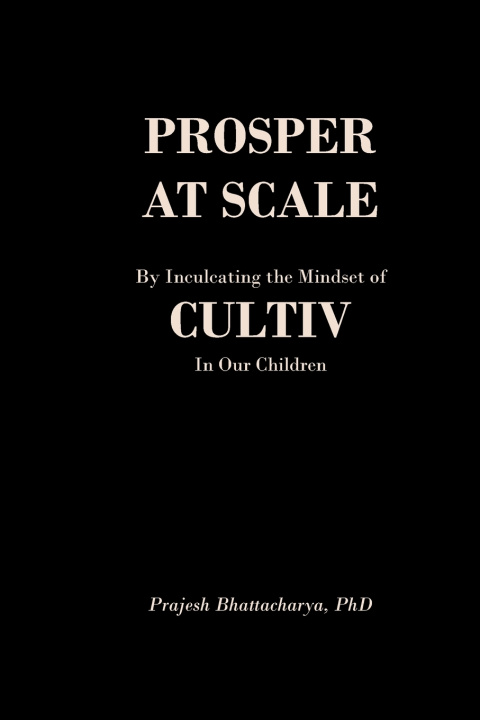
To help individuals, institutions, and societies to break free of the above and to prosper at scale, this book introduces the CULTIV framework and proposes inculcating the CULTIV mindset in humans right from their childhood.
The Central Thesis
CULTIV is the name given in this book to a way of thinking that makes sustained prosperity possible. It stands for Building Capability Relentlessly, Thriving in Uncertainty, Building Leverage Continuously, Seeing Cause and Effect Across Time, Playing Infinite Games, and Providing Value to Others.
CULTIV is not a list of six independent subjects, nor is it a set of boxes to be checked. Each pillar itself is composed of multiple underlying habits, skills, and perspectives. Many of those underlying aspects appear across more than one pillar, and most are deeply interdependent. Progress in one dimension often reinforces progress in others; neglect in one frequently weakens the rest.
One cross‑cutting force that needs special mention is association-the people, norms, expectations, and behaviors one is immersed in daily. This particular dimension is so omnipresent that instead of having a dedicated chapter on this one, the content regarding association is embedded in almost every chapter in an implicit way.
The Arc of the Book
Chapters 1 through 15 of this book examine the aspects underlying the pillars of CULTIV in detail-through mental models, case studies, historical examples, and practical reasoning-without attempting to force them into artificial boundaries. Together, they describe the real mechanics by which individuals, families, institutions, and societies either compound strength over time or quietly drift into fragility.
Every idea in this book ultimately points to one question: If we understand how prosperity is actually created, why do we keep teaching children the opposite?
The final chapter-the summit of the book-takes everything discussed in Chapters 1 through 15 and turns it into a training framework that can be used to train people in CULTIV. The chapter describes how to redesign education so that the next generation is not confused, fragile, or resentful, but capable, adaptable, and grounded in reality; not to create perfect people, but to create citizens who can thrive in an uncertain world-and keep society functional when conditions change.


Informace o knize
Angličtina

Darujte tuto knihu ještě dnes
Je to snadné
1 Přidejte knihu do košíku a zvolte doručit jako dárek 2 Obratem vám zašleme poukaz 3 Kniha dorazí na adresu obdarovanéhoAhoj! Jsem Libroamiko, tvůj knižní rádce.
Jak ti můžu pomoct?