
 Kontakt
 Jak nakupovat
Doručení
Nákupní rádce
 Angličtina
 38 b
38 b
 Nové
Nové
30 dní na vrácení zboží

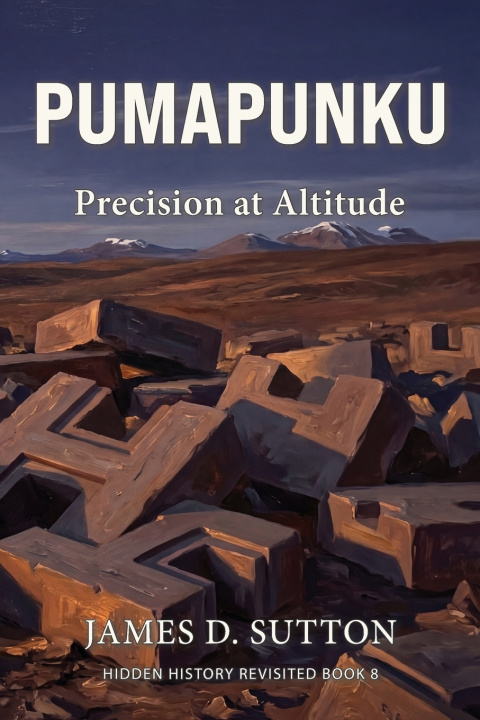
At 12,500 feet on the Bolivian Altiplano, scattered across the grass in the thin air, lie the remains of something that should not exist.
The H-blocks at Pumapunku are carved from andesite-volcanic stone as hard as steel-with flat surfaces, exact 90-degree angles, and interlocking modular forms so uniform that individual blocks can be swapped without losing fit. The miniature gateways are mathematically scaled replicas of full-sized monuments, produced in multiple copies. The approximately 900 perforations drilled into the stone are consistent in diameter down to the millimeter.
And the tools that produced all of this have never been found.
Jean-Pierre Protzen and Stella Nair, the UC Berkeley and UCLA scholars who conducted the definitive study of the stonework, concluded that the builders "resorted to techniques unknown to the Incas and to us at this time." Their experimental archaeology proved that some precision was achievable with stone tools. The flat interior surfaces were not.
Pumapunku: Precision at Altitude is the investigation that the popular treatments skip and the academic monographs don't attempt. Nine chapters. Three competing explanations-orthodox stone tools, Davidovits's peer-reviewed geopolymer hypothesis, and the alternative community's lost-knowledge argument. The full evidence for each. The documented problems with each. And the honest assessment of what remains open.
This is not an impossibility argument. Protzen and Nair demonstrated that precision is partially achievable. This is not an ancient astronaut book-no extraterrestrial intervention is proposed or entertained. This is not a denial of indigenous achievement-the Tiwanaku civilization was an Andean accomplishment, full stop.
This is the engineering investigation. What the stones actually show. What the competing explanations can and cannot account for. And why the geopolymer hypothesis-published in Materials Letters and Ceramics International by Elsevier, not self-published-deserves the serious engagement it has not yet received.
The dating debate. The destruction narrative. The living Aymara connection. The solstice at Tiwanaku. Every claim sourced to verified research. Every scientific debate presented with both sides at full strength.
The stones are in front of us. The evidence is what it is.
Hidden History Revisited is an investigative nonfiction series examining the sites, artifacts, and hypotheses that challenge the orthodox archaeological narrative. Each book investigates a single subject from a position of sympathetic curiosity-taking the questions seriously, demanding evidence, and scoring the claims honestly.


Informace o knize
Angličtina
