
 Kontakt
 Jak nakupovat
Doručení
Nákupní rádce
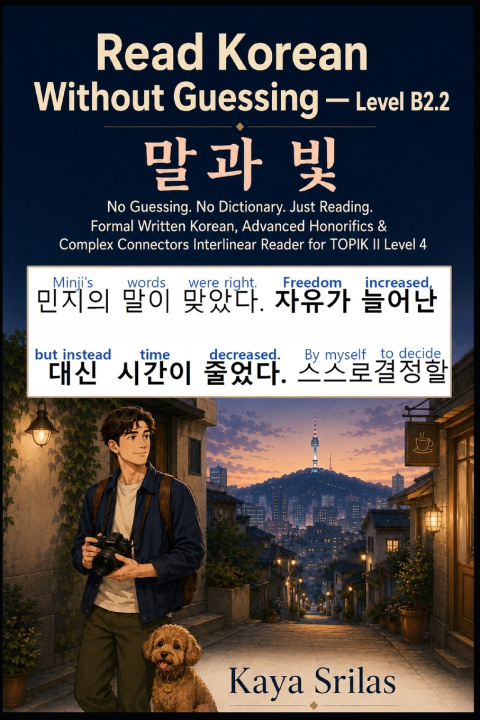
Read Korean Without Guessing - Level B2.2
말과 빛 - No Guessing. No Dictionary. Just Reading. Formal Written Korean, Advanced Honorifics & Complex Connectors Korean Graded Reader for TOPIK II Level 4
 Angličtina
 65 b
65 b
 Nové
Nové
Až 30 dní na vrácení zboží

Read Korean Without Guessing - Level B2.2
말과 빛 - Words and Light
Lucas is no longer only speaking Korean. He is writing it.
이것은 서울의 이야기다. 힘들었는데도 끝까지 해냈다.
That quiet −다 ending is not the conversational −요 of daily life. It is 한다체 - the written voice of books, essays, and serious reflection. This is the grammar of authorship.
Welcome to 말과 빛, the eighth book in the Read Korean Without Guessing series and the completion of TOPIK II Level 4. Lucas has arrived in Seoul, made friends, formed opinions, and entered professional life. Now he faces something harder: becoming a writer.
A Seoul Photo Book. A New Written Voice.
An editor commissions Lucas to create a Seoul photo book - with essays he must write himself. He is pushed to reshoot, made to wait, challenged by deadlines, and forced to express what he sees with precision.
For the first time, Korean becomes published prose: formal, reflective, and nuanced. By the end, the newcomer who once struggled to say hello has created a book about his new home.
What Makes Level B2.2 Different?
B2.1 gave you the passive, causative, and honorific-humble system. B2.2 refines them into mature Korean thought: concession, contrast, reasoning, conviction, correlated change, formal circumstance, and written style.
- Being made to do things - Korean has no single causative-passive. Learn −아/어야 했다, 시키다, −게 되다, and 어쩔 수 없이.
- Advanced honorific speech - move from correct politeness to graceful requests: 확인해 주시겠어요?, 해 주실 수 있을까요?, 해 주시면 감사하겠습니다.
- Written Korean - master 한다체: 간다, 먹는다, 좋다, 작가다, 갔다, 갈 것이다.
- Complex connectors - express "despite," "whereas," "instead," "the more...the more," and "in the process of."
- Reasoning and conviction - use −것이다, −기 때문이다, −는 것은 아니다, −ㄹ 리가 없다, and −아/어야 한다.
The Interlinear Method
이것은this 서울의Seoul's 이야기다.is a story. 시간이time 지날수록the more it passed 잘하게better 됐다.I became.
The English appears directly with Korean, so you can read without guessing or searching. Read interlinear first. Then read Korean-only and see what stays.
- Interlinear story for comprehension
- Korean-only story for active reading practice
- TOPIK-style exercises for reading, vocabulary, grammar, and writing
- Answer key and appendices for review and self-study
Inside the Story
Lucas is a 26-year-old photographer learning to become an author. Coco, his small brown dog, stays beside him. Minji becomes his first reader. Mr. Park's café becomes the heart of the photo book. Seoyeon helps him professionally. Han Jiwoo, a demanding but fair editor, pushes him until he finds his voice.
Book Specifications
- Level: B2.2, Upper Intermediate
- Exam alignment: TOPIK II Level 4, Part 2
- Chapters: 10, with 1500-2000 words each
- Writing system: Hangul only, no Hanja
- Registers: 해요체, formal honorific speech, and written 한다체
Complete TOPIK II Level 4
By the end, you will read longer Korean sentences with layered meaning and express pressure, obligation, polite requests, formal writing, contrast, reasoning, certainty, and change with greater control.
You will also recognize Sino-Korean patterns such as −적, −화, −성, −력, and −감, helping you decode abstract words like


Informace o knize
Angličtina

Darujte tuto knihu ještě dnes
Je to snadné
1 Přidejte knihu do košíku a zvolte doručit jako dárek 2 Obratem vám zašleme poukaz 3 Kniha dorazí na adresu obdarovanéhoAhoj! Jsem Libroamiko, tvůj knižní rádce.
Jak ti můžu pomoct?