
 Kontakt
 Jak nakupovat
Doručení
Nákupní rádce
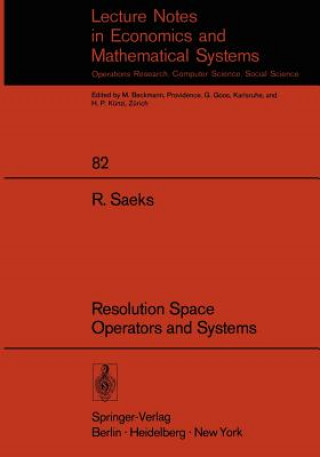
Resolution Space, Operators and Systems
 Angličtina
 236 b
236 b
Až 30 dní na vrácení zboží
Zákazníci také koupili

 /
/
 Brožovaná
 176
Kč
176
Kč














If one takes the intuitive point of view that a system is a black box whose inputs and outputs are time functions or time series it is natural to adopt an operator theoretic approach to the stUdy of such systems. Here the black box is modeled by an operator which maps an input time function into an output time function. Such an approach yields a unification of the continuous (time function) and discrete (time series) theories and simultaneously allows one to formulate a single theory which is valid for time-variable distributed and nonlinear systems. Surprisingly, however, the great potential for such an approach has only recently been realized. Early attempts to apply classical operator theory typically having failed when optimal controllers proved to be non-causal, feedback systems unstable or coupling networks non-lossless. Moreover, attempts to circumvent these difficulties by adding causality or stability constraints to the problems failed when it was realized that these time based concepts were undefined and; in fact, undefinable; in the Hilbert and Banach spaces of classical operator theory.


Informace o knize
Angličtina
Kategorie

Darujte tuto knihu ještě dnes
Je to snadné
1 Přidejte knihu do košíku a zvolte doručit jako dárek 2 Obratem vám zašleme poukaz 3 Kniha dorazí na adresu obdarovanéhoMohlo by vás také zajímat







 /
Brožovaná
608
Kč
/
Brožovaná
608
Kč
 /
Brožovaná
403
Kč
/
Brožovaná
403
Kč










Ahoj! Jsem Libroamiko, tvůj knižní rádce.
Jak ti můžu pomoct?