
 Kontakt
 Jak nakupovat
Doručení
Nákupní rádce
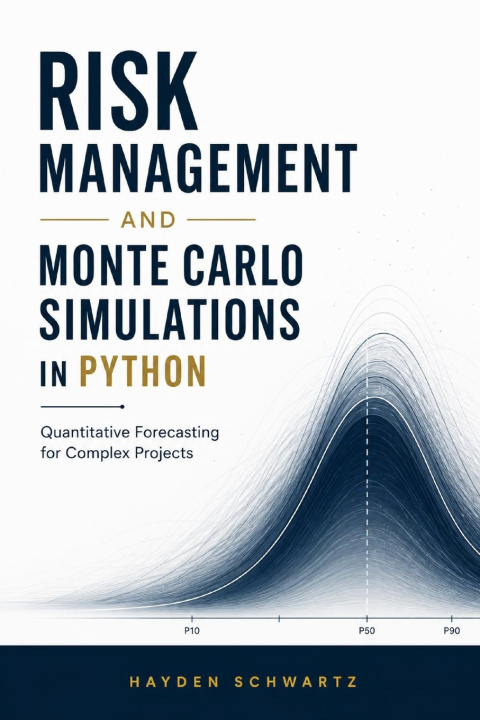
Risk Management and Monte Carlo Simulations in Python
Quantitative Forecasting for Complex Projects
 Angličtina
 97 b
97 b
 Připravujeme
 Nové
Nové
Až 30 dní na vrácení zboží

Reactive Publishing
Master the quantitative tools required to model uncertainty, stress-test financial and operational assumptions, and forecast outcomes in complex project environments.
Modern project management and risk analysis often rely on static estimates that fail to account for real-world volatility. Risk Management and Monte Carlo Simulations in Python provides a practical, code-first framework for building custom stochastic models using modern Python libraries.
This guide bridges the gap between theoretical risk frameworks and hands-on computational implementation. You will learn how to transition from basic deterministic forecasting to advanced probabilistic modeling, allowing you to identify tail risks, quantify variance, and make data-driven decisions under uncertainty.
Inside, you will learn how to:
Structure Risk Models: Map project variables, dependencies, and cost drivers into clean, scalable Python architectures.
Select and Fit Probability Distributions: Apply Normal, Lognormal, Beta, and Triangular distributions to model realistic schedule and budget variations.
Execute Monte Carlo Engines: Leverage NumPy and Pandas to run high-volume vectorised simulations efficiently.
Analyze and Interpret Output: Generate cumulative probability distributions (S-curves), confidence intervals, and sensitivity analyses (tornado charts).
Account for Correlation: Model correlated risks and variance tail events to prevent underestimating compound project risks.
Designed for quantitative analysts, project managers, systems engineers, and Python practitioners, this book delivers the functional scripts and analytical patterns needed to build robust forecasting engines from scratch.


Informace o knize
Angličtina

Darujte tuto knihu ještě dnes
Je to snadné
1 Přidejte knihu do košíku a zvolte doručit jako dárek 2 Obratem vám zašleme poukaz 3 Kniha dorazí na adresu obdarovanéhoAhoj! Jsem Libroamiko, tvůj knižní rádce.
Jak ti můžu pomoct?