
 Kontakt
 Jak nakupovat
Doručení
Nákupní rádce
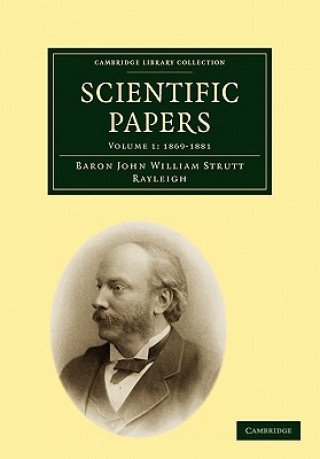
Scientific Papers
 Angličtina
 157 b
157 b
Až 30 dní na vrácení zboží
Zákazníci také koupili


Lord Rayleigh (1842–1919) won the Nobel Prize for physics in 1904. His early research was in optics and acoustics but his first published paper, from 1869, was an explanation of Maxwell's electromagnetic theory. In 1871, he related the degree of light scattering to wavelength (part of the explanation for why the sky is blue), and in 1872 he wrote his classic Theory of Sound (not included here). He became a Fellow of the Royal Society and inherited his father's peerage in 1873. Rayleigh nevertheless continued groundbreaking research, including the first description of Moiré interference (1874). In 1881, while president of the London Mathematical Society (1878–1880) and successor to Maxwell as Cavendish Professor of Experimental Physics at Cambridge (1879–1884), Rayleigh published a paper on diffraction gratings which led to improvements in the spectroscope and future developments in high-resolution spectroscopy. This volume contains papers from 1869 to 1881.


Informace o knize
Angličtina

Darujte tuto knihu ještě dnes
Je to snadné
1 Přidejte knihu do košíku a zvolte doručit jako dárek 2 Obratem vám zašleme poukaz 3 Kniha dorazí na adresu obdarovanéhoMohlo by vás také zajímat
 /
/
 Pevná
Pevná
 3 828
Kč
3 828
Kč

Ahoj! Jsem Libroamiko, tvůj knižní rádce.
Jak ti můžu pomoct?