
 Kontakt
 Jak nakupovat

Doručení
Nákupní rádce
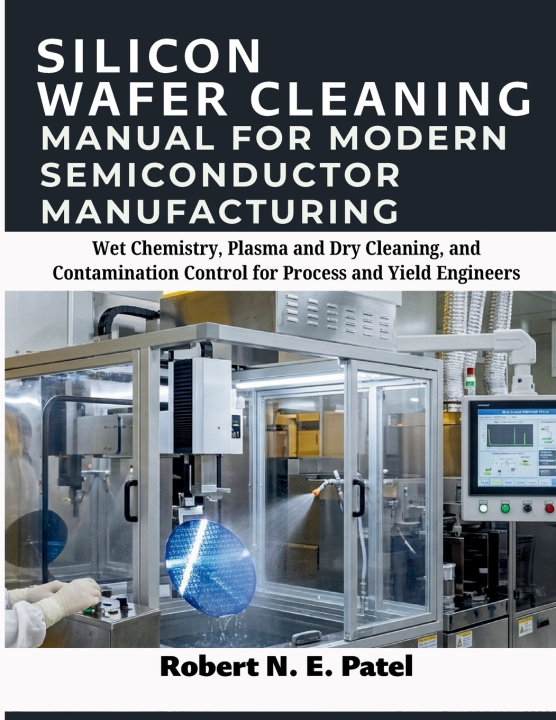
Silicon Wafer Cleaning Manual for Modern Semiconductor Manufacturing
Wet Chemistry, Plasma and Dry Cleaning, and Contamination Control for Process and Yield Engineers
 Angličtina
 379 b
 Nové
Až 30 dní na vrácení zboží
Zákazníci také koupili


One Particle, One Ruined Wafer, One Very Expensive Lesson
A leading-edge 300 millimeter wafer can carry tens of thousands of dollars in accumulated process value by the time it reaches its final cleaning step, and surface preparation touches that wafer before or after nearly every oxidation, etch, implant, and planarization along the way, accounting for roughly a third of all fabrication operations. One unaddressed particle, metallic trace, or drying watermark at that point does not just cost time. It can destroy a die outright or seed a reliability failure that only shows up months later in the field.
This manual was written for the engineer who has to prevent that outcome, not just react to it. Rather than presenting cleaning steps as recipes to follow, it derives the physics and chemistry that make each method work, so the same reasoning that sizes a clean also diagnoses one that has failed.
How the Chemistry Actually Works- Particle removal is built on van der Waals attraction, capillary forces, and electrostatic double layer interactions. The book shows how SC-1 (APM) pairs a mild oxide etch with a high pH zeta potential that repels particles once they lift, preventing redeposition rather than just dislodging debris.
- Metal extraction hinges on electrochemistry, not brute force. Electropositive metals such as iron, aluminum, and zinc dissolve readily in acid, while noble metals such as copper and silver plate back onto bare silicon by galvanic displacement the instant the surface loses its oxide. SC-2 (HPM) and dilute acidic chemistries are explained as tools for keeping those ions oxidized and complexed so they stay in solution.
- Acoustic cleaning is treated quantitatively. Megasonic transducers operating near 0.8 to 1.2 megahertz balance acoustic streaming against controlled cavitation, and the book works through exactly how that balance shifts on fragile fins and high aspect ratio trenches before pattern collapse becomes a risk.
- Drying physics gets the same treatment, covering Marangoni drying, IPA vapor displacement, and supercritical carbon dioxide as three distinct answers to the same problem, eliminating the capillary forces and silica precipitation that cause watermarks.
- Advanced structures including SiGe, III-V materials, high-k metal gates, gate-all-around nanosheets, 3D NAND trenches, and packaging steps such as through-silicon vias and hybrid bonding are each addressed for where the standard clean breaks down and what replaces it.
- Root cause diagnosis closes the loop, connecting defect signatures from TXRF, VPD, XPS, and dark-field inspection back to the specific mechanism responsible, using the same troubleshooting method taught throughout the book.
What You Actually Get
Every mechanism is followed by a worked numerical example with real units and a discussion of what the arithmetic means on a production line, and every chapter ends with a mix of concept, quantitative, and applied decision questions, roughly 600 in total, fully resolved in the included answer key. Four appendices, a standards index, and a complete glossary make it a standing desk reference rather than a book read once and shelved.
Who This Manual Is Built For
Process and yield engineers eliminating defect density, wet process and CMP specialists designing dilute and sustainable chemistries, integration and packaging engineers managing queue time across FEOL and BEOL modules, and students or technicians entering cleanroom and contamination control roles.
Turn your approach to wafer cleaning from inherited habit into predictable, defensible engineering. Order your copy today.


Informace o knize
Angličtina

Darujte tuto knihu ještě dnes
Je to snadné
1 Přidejte knihu do košíku a zvolte doručit jako dárek 2 Obratem vám zašleme poukaz 3 Kniha dorazí na adresu obdarovanéhoMohlo by vás také zajímat


 /
 Brožovaná
 491
Kč



 /
Pevná
3 422
Kč



 /
Pevná
3 765
Kč



Ahoj! Jsem Libroamiko, tvůj knižní rádce.
Jak ti můžu pomoct?