
 Kontakt
 Jak nakupovat

Doručení
Nákupní rádce
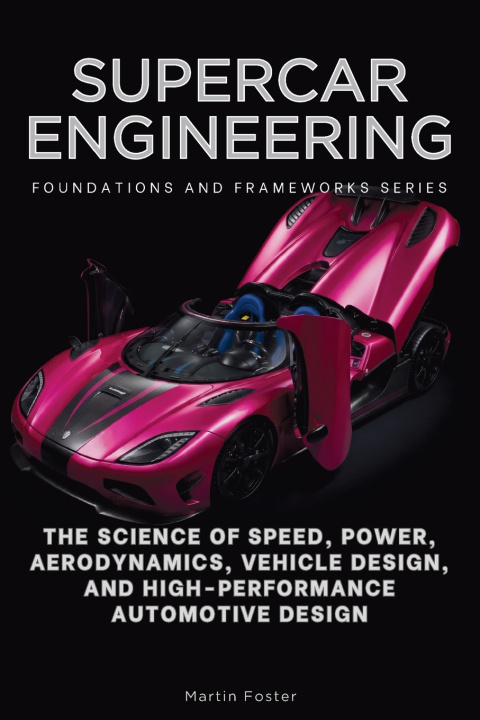
Supercar Engineering
The Science of Speed, Power, Aerodynamics, Vehicle Design, and High-Performance Automotive Design
 Angličtina
 39 b
 Připravujeme
 Nové
Až 30 dní na vrácení zboží

Supercar engineering explained with basic algebra and real numbers from McLaren, Ferrari, Bugatti, Porsche, and Rimac. Learn how the fastest road cars accelerate, corner, brake, breathe, cool themselves, and stay stable at speeds most cars never reach.
Ten chapters build on each other. The first covers force, torque, friction, and weight transfer, and the last shows how electronics, testing, and hand assembly turn separate systems into a finished car.
Every equation is worked out step by step, and every tradeoff is traced to a car you can look up yourself. More downforce costs top speed. A bigger turbo adds lag. Wider tires add weight. Once you learn to spot these choices, you will see them in every car you read about.
The ten chapters walk through:
- Why doubling a car's speed takes about eight times the power just to push through the air
- Mid-engine layouts, polar moment of inertia, and how a carbon fiber monocoque differs from an aluminum spaceframe
- V8, V10, V12, W16, and flat-six engines, forged pistons, titanium connecting rods, and why a flat-plane Ferrari V8 sounds nothing like a cross-plane Corvette
- Turbochargers, intercoolers, dry-sump oiling, and the ten radiators the Bugatti Veyron needed to shed the heat of its 1,001 horsepower W16
- Hybrid and electric hypercar powertrains: P0 to P4 motor placement, axial flux motors, 800-volt battery packs, and silicon carbide inverters
- Dual-clutch gearboxes, launch control, and torque vectoring
- Pushrod suspension, magnetorheological dampers, slip angle, contact patches, and carbon-ceramic brakes
- Downforce, diffusers, ground effect, and the Brabham BT46B fan car that won a single Grand Prix before its team withdrew it
Chapter 10 ties it together with stability control, Ferrari's Side Slip Control, wiring and vehicle networks, cockpit ergonomics, crash and emissions homologation, rolling-road wind tunnels, and Nürburgring testing.
Each chapter closes with questions, and a separate section gives example responses so you can check your reasoning. A timeline runs from the 1886 Benz Patent-Motorwagen through the Lamborghini Miura to today's electric hypercars, followed by a glossary of terms, references, and recommended readings for further study.
This book is written for:
- Students in mechanical or automotive programs
- Engineers from other fields curious about fast cars
- Car enthusiasts who read spec sheets and want to know what the numbers mean
- Track day drivers and sim racers who want to understand setup
- Teachers looking for a course companion built on real cars
Pick a favorite car before you start and test each idea against it as you read. Once you hit the last page you will know where the 800 kilograms of downforce on a McLaren Senna goes, how much top speed that load costs, and why the engine bay of a McLaren F1 is lined with gold. The next time you walk past a parked supercar, you will be able to tell what each vent feeds.


Informace o knize
Angličtina

Darujte tuto knihu ještě dnes
Je to snadné
1 Přidejte knihu do košíku a zvolte doručit jako dárek 2 Obratem vám zašleme poukaz 3 Kniha dorazí na adresu obdarovanéhoAhoj! Jsem Libroamiko, tvůj knižní rádce.
Jak ti můžu pomoct?