
 Kontakt
 Jak nakupovat
Doručení
Nákupní rádce
 Angličtina
 64 b
64 b
 Připravujeme
 Nové
Nové
Až 30 dní na vrácení zboží

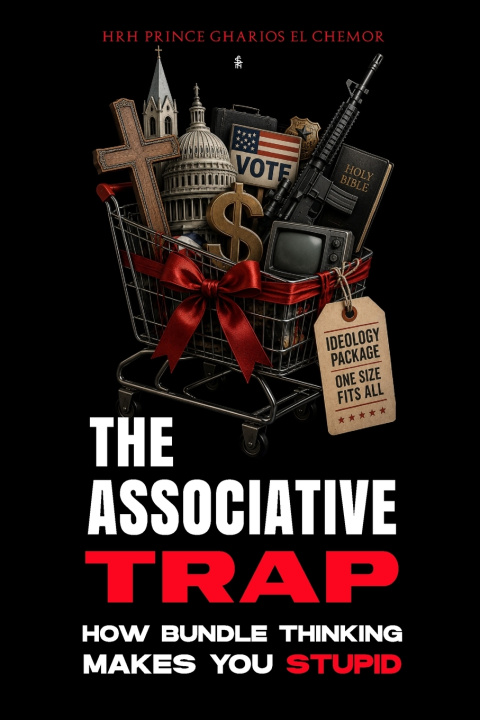
What if some of your strongest beliefs aren't really yours?
Most books about critical thinking focus on confirmation bias, logical fallacies, misinformation, and cognitive biases. The Associative Trap identifies a deeper problem: human beings rarely acquire beliefs one at a time. We acquire them in bundles.
Political parties bundle positions on subjects that have no necessary logical relationship. Religions combine teachings, traditions, interpretations, and doctrines developed across different historical periods. Cultural groups transmit assumptions before children are old enough to question them. Even science can become bundled with philosophical, institutional, or political claims that extend beyond what the evidence itself establishes.
Once we accept part of a package, something remarkable happens: credibility begins spreading from the ideas we examined to ideas we didn't.
HRH Prince Gharios El Chemor calls this mechanism Associative Belief Adoption.
And intelligence does not necessarily protect us from it.
Smart people can simply become better at rationalizing the packages they already possess.
Drawing from cognitive psychology, epistemology, behavioral science, political psychology, sociology, philosophy of science, religious studies, and critical-thinking research, The Associative Trap examines the mechanisms that keep belief bundles together, including confirmation bias, motivated reasoning, tribal thinking, identity capture, authority bias, emotional reasoning, narrative thinking, groupthink, the halo effect, and the craving for certainty.
At the heart of the book is the Principle of Proposition Independence:
Every proposition should be evaluated on its own evidence and reasoning unless a genuine logical dependency connects it to another proposition.
This does not mean rejecting experts, traditions, communities, or inherited knowledge. Nor does it mean becoming cynical or automatically disagreeing with everyone else. Contrarianism can become just another form of dependence.
Instead, The Associative Trap teaches readers how to separate logical dependence from mere association, identify beliefs that have borrowed credibility from their neighbors, map the hidden architecture of a worldview, and reconstruct a coherent system of beliefs one proposition at a time.
The question running through the book is extraordinarily simple:
Would you still believe it if the same idea came from someone you disliked, a political party you opposed, or a tradition that wasn't your own?
Your answer may reveal how much of your worldview you actually chose.
The Associative Trap is for readers interested in critical thinking, cognitive biases, psychology, philosophy, logical reasoning, independent thinking, political polarization, intellectual autonomy, epistemology, decision-making, media literacy, misinformation, and the psychology of belief.
Stop buying ideas in packages.
Open the box.
Examine what is inside.
Build a worldview that has earned your belief.


Informace o knize
Angličtina

Darujte tuto knihu ještě dnes
Je to snadné
1 Přidejte knihu do košíku a zvolte doručit jako dárek 2 Obratem vám zašleme poukaz 3 Kniha dorazí na adresu obdarovanéhoAhoj! Jsem Libroamiko, tvůj knižní rádce.
Jak ti můžu pomoct?