
 Kontakt
 Jak nakupovat
Doručení
Nákupní rádce
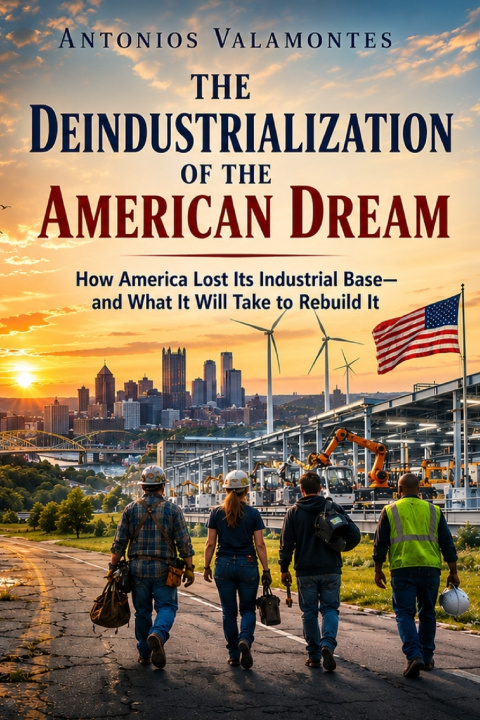
The Deindustrialization of the American Dream
 Angličtina
 55 b
55 b
 Nové
Nové
Až 30 dní na vrácení zboží

America did not simply lose factories. It lost an economic system that once connected productivity, wages, communities, and national power.
The Deindustrialization of the American Dream traces how the United States moved from the world's dominant industrial economy to a country marked by shuttered mills, hollowed-out manufacturing cities, fragile supply chains, and a working class increasingly separated from the prosperity it helped create.
Beginning with the postwar industrial bargain, the book follows the long unraveling through automation, suburbanization, aging capital, foreign competition, corporate restructuring, union decline, NAFTA, China's entry into the global trading system, and the transformation of American production networks.
But this is not a monocausal account.
Deindustrialization was shaped by technology, trade, finance, management decisions, geography, and public policy. Successive presidents and Congresses made consequential choices about tariffs, trade agreements, labor, taxation, procurement, industrial investment, and adjustment assistance. Some policies accelerated displacement. Others attempted to contain it. More recently, both parties have begun rebuilding forms of industrial policy that Washington had largely abandoned.
Drawing on federal statistics, historical records, economic research, labor-market studies, and contemporary industrial-policy evidence, the book examines:
- Youngstown, Detroit, Flint, Gary, and the geography of industrial decline
- NAFTA, China, offshoring, and global procurement
- automation and the productivity-versus-trade debate
- racial inequality, migration, household change, and the social consequences of factory loss
- opioids, mortality, and the limits of economic explanations
- political realignment and the rise of industrial populism
- what actually replaced the factory job
- the decline of the defense-industrial base
- energy, water, grids, permitting, and the physical requirements of reindustrialization
- CHIPS, the IRA, tariffs, reshoring, and the new American industrial policy
- Germany, Japan, and South Korea as alternative industrial models
The final question is not whether America can recreate the factory economy of 1955.
It is whether a modern, highly automated industrial economy can once again connect productive capacity to secure work, strong communities, technological independence, national resilience, and broadly shared prosperity.
The Deindustrialization of the American Dream is a history of what America lost-and a rigorous examination of what rebuilding would actually require.


Informace o knize
Angličtina

Darujte tuto knihu ještě dnes
Je to snadné
1 Přidejte knihu do košíku a zvolte doručit jako dárek 2 Obratem vám zašleme poukaz 3 Kniha dorazí na adresu obdarovanéhoAhoj! Jsem Libroamiko, tvůj knižní rádce.
Jak ti můžu pomoct?