
 Kontakt
 Jak nakupovat
Doručení
Nákupní rádce
The European Union
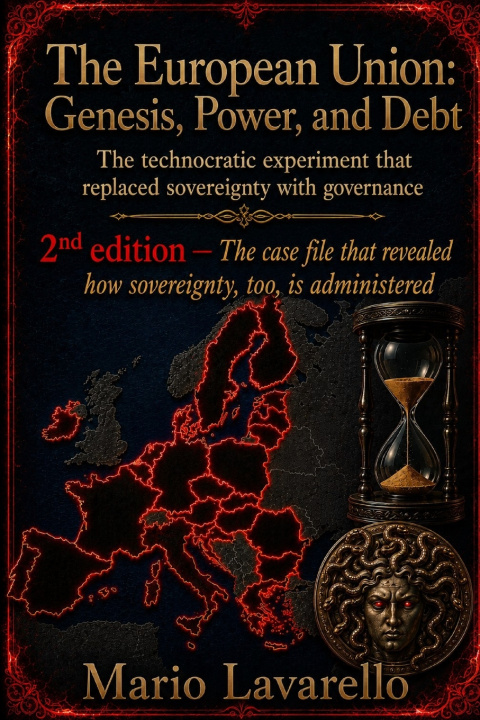
Genesis, Power, and Debt: The technocratic experiment that replaced sovereignty with governance: 2nd edition - The case file that revealed how sovereignty, too, is administered
 Angličtina
 65 b
65 b
 Nové
Nové
Až 30 dní na vrácení zboží

Abstract
The European Union: Genesis, Power and Debt - 2nd Edition examines the European architecture as a historical, economic, monetary, political, and legal system, asking what happens when supranational institutions attempt to govern heterogeneous national realities through common rules and decision-making mechanisms removed from the direct sovereignty of States.
The first edition approached the problem from economics: the genesis of European integration, the technocratic method, Maastricht, the creation of the euro, common monetary policy, sovereign debt, promised convergence versus actual divergence, international trade and its distributive effects, the crisis of European agriculture, and the relationship between budget, priorities, and legitimacy. The central argument is that eliminating the exchange rate and centralizing monetary policy reduced national adjustment mechanisms, shifting part of the resulting imbalances onto debt, fiscal discipline, and implicit transfers. The European experience is analyzed through historical parallels with Rome, Byzantium, Charlemagne, and Napoleon, to study center and periphery, institutional rigidity, dependence, and capacity for reform.
The second edition expands this framework. Parts XI through XIV carry the same question from economics toward law, citizenship, and political representation: who decides, with what legitimacy, and what happens when the individual is caught between different institutional levels without any single authority assuming full responsibility? The work examines the supranational judicial architecture, the Court of Justice of the European Union, the General Court, the European Court of Human Rights, and the European Commission, before descending into the Italian case and the reform of citizenship iure sanguinis.
The empirical core is fascicolo n. 20092, opened within the Italian consular system in 2019 and reconstructed through genealogy, civil records, correspondence, a formal diffida, and the Consulate's riscontro. The case allows a macro-scale problem to be observed at human scale: the distance between the formal existence of a right, the institutions required to recognize it, and the time needed to make it operative. This second edition further documents Italy's 2025 reform, the case law of its highest courts, the referral to Luxembourg, and the parallel front before Strasbourg.
One controversial section raises the hypothesis of a possible relationship between the restriction of citizenship by descent and the parallel reform of the electoral representation of Italians abroad. The author distinguishes between verified institutional fact, fact documented through primary sources, and interpretation. Temporal coincidence, the scale of pending proceedings, and the language used by the case law itself constitute evidence; the existence of deliberate political intent remains presented as hypothesis, not as proven fact.
The result is an essay in political economy and institutional history that reads the European Union without reducing it to slogans. Its thesis is that the problem does not necessarily lie in individual intentions, but in the design of complex systems: when authority is centralized, responsibility becomes diffuse, correction mechanisms grow rigid, and institutional time begins to operate as a variable of power - economic tensions end up becoming social, political, and legal tensions.
This second edition offers no closed conclusion to a process still underway. Its purpose is to record the architecture while it acts, and to show how a single logic of governance can run through currency, debt, trade, representation, and citizenship.


Informace o knize
Angličtina

Darujte tuto knihu ještě dnes
Je to snadné
1 Přidejte knihu do košíku a zvolte doručit jako dárek 2 Obratem vám zašleme poukaz 3 Kniha dorazí na adresu obdarovanéhoAhoj! Jsem Libroamiko, tvůj knižní rádce.
Jak ti můžu pomoct?