
 Kontakt
 Jak nakupovat
Doručení
Nákupní rádce
 Angličtina
 42 b
42 b
 Nové
Nové
Až 30 dní na vrácení zboží

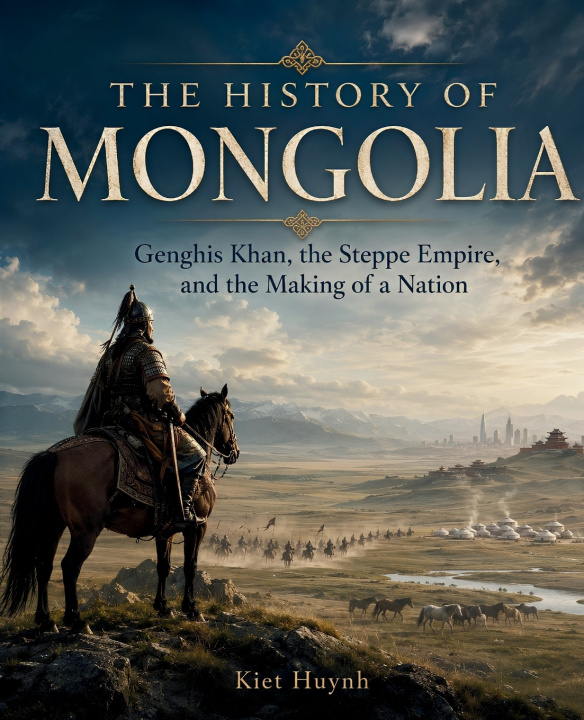
A people of roughly one million redrew the map of the world. Then they nearly vanished from it.
Around the year 1200 the eastern steppe held no cities, no coinage, no writing in daily use, and fewer people than live today in a mid-sized town. Within a single lifetime their grandchildren were collecting taxes in Korea, sitting on the throne of China, and receiving nervous ambassadors from the Pope. Eight centuries later their descendants govern a nation of 3.5 million squeezed between Russia and China, where roughly a third of the workforce still lives by its herds.
This is the whole arc, in one volume. It begins on the grass, with how a family actually survived a winter at minus 40, what a felt tent was made of, how a marriage was arranged and what a funeral looked like. It moves through the assembly of 1206 that turned a winning coalition into a state, through the decimal army and the relay riders who covered two to three hundred kilometers a day, through Baghdad and the Yangtze and the four khanates that split the inheritance. Then it keeps going, where most books stop: the retreat to the steppe, two centuries under the Qing, the purges that destroyed seven hundred monasteries, the Soviet century, and the country that emerged from it.
Numbers run through every page, because the scale is the story. Draw weights and effective ranges. Relay-station spacing. Tax rates and caravan margins. Herd counts and livestock lost to a single winter. And where the sources disagree, as they constantly do, this book says so plainly rather than picking the most dramatic figure and hoping you don't check.
No background required. Fifty-four illustrations. One continuous story, from the grass to the present day.


Informace o knize
Angličtina

Darujte tuto knihu ještě dnes
Je to snadné
1 Přidejte knihu do košíku a zvolte doručit jako dárek 2 Obratem vám zašleme poukaz 3 Kniha dorazí na adresu obdarovanéhoAhoj! Jsem Libroamiko, tvůj knižní rádce.
Jak ti můžu pomoct?