
 Kontakt
 Jak nakupovat
Doručení
Nákupní rádce
 Angličtina
 202 b
202 b
Až 30 dní na vrácení zboží
Zákazníci také koupili























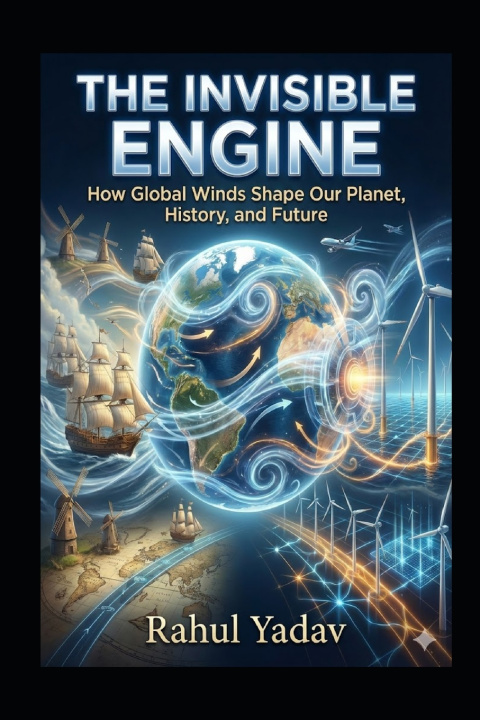
This book argues a single, unifying idea:
Wind is not a background feature of Earth-it is the planet's operating system.
From the first chapter to the final epilogue, The Invisible Engine traces how sunlight, pressure gradients, planetary rotation, and friction combine to generate a global atmospheric circulation that governs climate, ecosystems, transportation, agriculture, architecture, energy systems, and the persistence of extreme weather.
Core Narrative
The book begins with fundamental physics-how uneven solar heating creates pressure differences, how Earth's rotation bends moving air through the Coriolis effect, and how friction allows storms to exist. These primordial forces build the scaffolding of the atmosphere.
That scaffolding organizes itself into the Three-Cell Model-Hadley, Ferrel, and Polar circulations-which redistribute heat from equator to pole and anchor the world's deserts, rain belts, and storm tracks.
From this planetary framework emerge the great wind systems:
Trade Winds, converging at the ITCZ and regulating ocean currents and El Niño cycles.
Westerlies, Earth's primary storm carriers, roaring around the Southern Hemisphere and steering midlatitude cyclones.
Polar Easterlies, exporting frigid air from ice caps and energizing winter storms.
The narrative then ascends into the upper atmosphere, where jet streams, Rossby waves, and stratospheric circulations quietly decide where heat waves stall, where blizzards erupt weeks later, and how monsoons evolve seasonally.
The book reframes monsoons not as rainfall events but as continental-scale wind reversals, driven by land-sea heating contrasts, mountain ranges, and shifting jets-systems that sustain billions of people across Asia, Africa, and the Americas.
Zooming down to regional scales, it explores local winds-sea breezes, mountain-valley flows, katabatic surges, foehn winds, and desert dust storms-and shows how these mesoscale circulations shape vineyards, wildfire behaviour, aviation safety, urban comfort, and soil survival.
The final technical sections reveal how modern society has learned to harness and negotiate with wind:
Wind-energy engineers analyze Weibull statistics, turbulence, shear, and turbine wakes.
Airlines ride jet streams to save fuel and orient runways using crosswind climatology.
Shipping routes still follow pressure gradients, now guided by satellites rather than sextants.
Architects sculpt skyscrapers to suppress vortex shedding, while farmers protect fields from erosion and disease spread.
The Future Focus
The closing chapters confront how climate change is reorganizing Earth's circulation:
expansion of the Hadley Cell and dry zones,
poleward shifts of storm tracks,
intensifying subtropical jets,
increasingly erratic monsoon behaviour,
debates over slower, amplified Rossby waves and "stuck" weather regimes.
The book emphasizes that the atmospheric engine is not uniformly accelerating-it is redistributing energy, creating new corridors of risk and opportunity.
Unifying Message
Across physics, history, engineering, and climate science, the book maintains a single through-line:
Wind redistributes heat, moisture, and momentum.
Wind links oceans to continents and stratosphere to surface.
Wind built trade routes and now powers renewable grids.
Wind sculpts coastlines, fertilizes forests, erodes soils, and drives disasters.
Human societies do not merely experience the wind.


Informace o knize
Angličtina
Kategorie

Darujte tuto knihu ještě dnes
Je to snadné
1 Přidejte knihu do košíku a zvolte doručit jako dárek 2 Obratem vám zašleme poukaz 3 Kniha dorazí na adresu obdarovanéhoMohlo by vás také zajímat


 /
/
 Brožovaná
 692
Kč
692
Kč




 /
Brožovaná
1 181
Kč
/
Brožovaná
1 181
Kč







 /
Brožovaná
308
Kč
/
Brožovaná
308
Kč








 /
Brožovaná
571
Kč
/
Brožovaná
571
Kč
Ahoj! Jsem Libroamiko, tvůj knižní rádce.
Jak ti můžu pomoct?