
 Kontakt
 Jak nakupovat
Doručení
Nákupní rádce
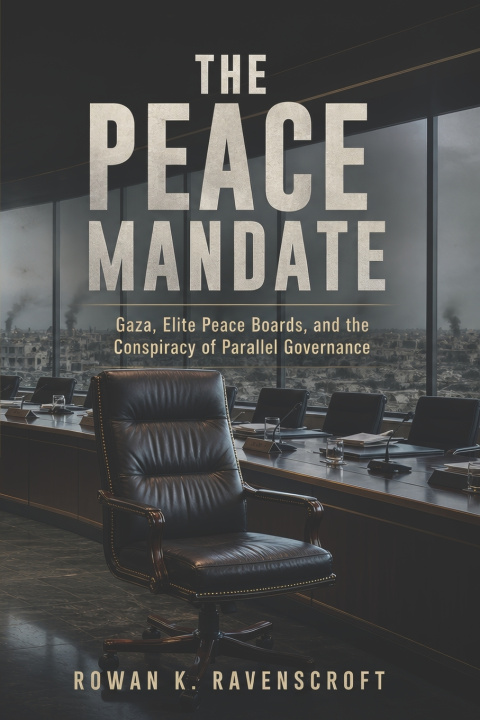
The Peace Mandate
Gaza, Elite Peace Boards, and the Conspiracy of Parallel Governance
 Angličtina
 32 b
32 b
 Nové
Nové
Až 30 dní na vrácení zboží

What happens when peace is announced before legitimacy is settled?
The Peace Mandate is an investigative nonfiction case file about Gaza, elite peace boards, reconstruction power, and the conspiracy pressure that forms when public authority, private capital, donor finance, security planning, and emergency governance converge in one devastated territory.
This book does not ask readers to accept a secret-world-government claim as fact. It does something colder, more careful, and more unsettling: it separates what is documented from what is alleged, what is plausible from what is proven, and what belongs to conspiracy culture from what belongs to serious institutional scrutiny. At the center is a simple but difficult question: when a peace-and-reconstruction mechanism gains influence over money, security, records, land, aid, contracts, and legitimacy, where does humanitarian coordination end and practical governance begin?
Gaza is the first frame. The book follows the Board of Peace as a public structure tied to ceasefire durability, reconstruction, demilitarization, humanitarian access, transitional administration, donor coordination, and future-use language that raises questions beyond one territory. The concern is not only whether a board can help rebuild. The concern is whether reconstruction can become a substitute for self-determination when the people most affected have limited power inside the mechanism deciding their future.
Written in a restrained, case-file style, The Peace Mandate moves through the public ceremony, the problem of existing international institutions, leadership optics, funding leverage, security-before-sovereignty frameworks, missing Palestinian representation, humanitarian data, proof of personhood, land records, property claims, emergency contracts, and the online conspiracy cascade. Each chapter keeps counter-evidence close to the claim and uses evidence grades to distinguish strong documentation, credible secondary support, plausible but unresolved material, and speculative claims.
This is a book for readers interested in Gaza reconstruction, Middle East politics, crisis governance, conspiracy analysis, international power structures, postwar recovery, humanitarian administration, and the hidden machinery of modern peace plans. It treats rumor as a social signal, not proof. It treats official language as evidence of framing, not automatic truth. It treats emergency power as something that may be necessary and still demand scrutiny.
The result is not a verdict delivered from the shadows. It is a guided examination of how power can move through forms, funds, maps, eligibility rules, security conditions, archives, procurement systems, and diplomatic ceremony. In a destroyed society, the most consequential decisions may not look dramatic. They may look administrative.
This Book Is For Readers Who...
- Want a careful nonfiction case file on Gaza reconstruction and elite peace governance
- Are interested in the tension between humanitarian aid, security, sovereignty, and consent
- Follow international politics, crisis management, donor power, and postwar rebuilding
- Want conspiracy claims examined without sensationalism or blind dismissal
- Care about records, land, identity, data systems, contracts, and return after war
Perfect For Readers Who Enjoy...
- Investigative nonfiction about power, secrecy, and institutional legitimacy
- Political analysis of war, peace frameworks, and international governance
- Case-file style nonfiction with evidence grades and chronology dockets
- Books about Gaza, reconstruction, displacement, sovereignty, and return
Peace is not only the absence of war. It is the presence of legitimacy.
Enter the case file and follow what the record can hold.


Informace o knize
Angličtina

Darujte tuto knihu ještě dnes
Je to snadné
1 Přidejte knihu do košíku a zvolte doručit jako dárek 2 Obratem vám zašleme poukaz 3 Kniha dorazí na adresu obdarovanéhoAhoj! Jsem Libroamiko, tvůj knižní rádce.
Jak ti můžu pomoct?