
 Kontakt
 Jak nakupovat
Doručení
Nákupní rádce
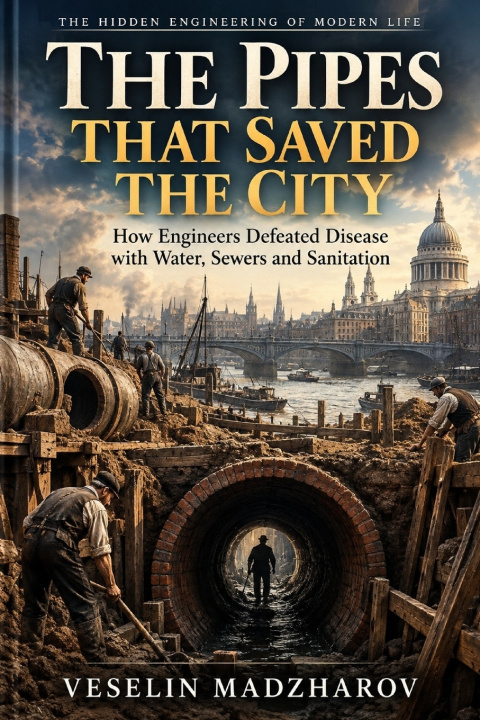
THE PIPES THAT SAVED THE CITY
How Engineers Defeated Disease with Water, Sewers and Sanitation
 Angličtina
 55 b
55 b
 Připravujeme
 Nové
Nové
Až 30 dní na vrácení zboží

THE PIPES THAT SAVED THE CITY
How Engineers Defeated Disease with Water, Sewers and Sanitation
Cities did not become modern because of monuments, factories, or electric lights.
They became modern when engineers learned how to move water in-and waste out.
In the nineteenth century, rapidly growing cities faced a crisis hidden beneath their streets. Wells were contaminated. Rivers became open sewers. Cholera moved through crowded neighborhoods with terrifying speed. London's Thames grew so polluted that Parliament itself could no longer ignore the stench.
The solution would require something unprecedented: an underground engineering system large enough to serve an entire metropolis.
THE PIPES THAT SAVED THE CITY tells the remarkable story of how engineers transformed water supply, drainage, sewerage, pumping, filtration, and sanitation into the invisible infrastructure on which modern urban life still depends.
At the center of the story stands Victorian London and the monumental sewer network designed under Joseph Bazalgette. But the book goes far beyond one engineer and one city.
It explores how disease changed engineering priorities, how John Snow's investigation of the Broad Street cholera outbreak challenged accepted beliefs, how the Great Stink forced political action, and how enormous brick sewers, steam-powered pumping stations, reservoirs, filters, embankments, and treatment works gradually changed the relationship between cities and water.
The story then follows the same engineering struggle beyond London-to Paris, Hamburg, Chicago, and the emerging science of public-health engineering.
Along the way, the reader discovers:
• why gravity became the most valuable "engine" in sewer design
• how engineers calculated gradients and flow before electronic instruments
• why Victorian sewers were often built in distinctive egg-shaped sections
• how steam pumping stations lifted sewage when gravity failed
• how filtration turned clear-looking water into safer water
• why moving pollution downstream was only a temporary solution
• how epidemics, floods, failures, and disasters changed engineering practice
• how modern wastewater treatment developed from nineteenth-century experiments
• why the systems beneath modern cities still depend on decisions made generations ago
This is not a plumbing manual and not a conventional textbook.
It is a narrative history of engineering under pressure-of crowded streets, polluted rivers, excavation works, steam engines, public fear, political resistance, scientific discovery, and the engineers who had to make cities survivable.
Written in the storytelling style of THE HIDDEN ENGINEERING OF MODERN LIFE, the book combines historical narrative with clear technical explanation, revealing both what engineers built and why their solutions worked.
Modern cities rarely celebrate their sewers.
Yet without them, modern cities could not exist.
Because civilization was not only built above ground.
Some of its greatest engineering achievements were buried beneath it.


Informace o knize
Angličtina

Darujte tuto knihu ještě dnes
Je to snadné
1 Přidejte knihu do košíku a zvolte doručit jako dárek 2 Obratem vám zašleme poukaz 3 Kniha dorazí na adresu obdarovanéhoAhoj! Jsem Libroamiko, tvůj knižní rádce.
Jak ti můžu pomoct?